
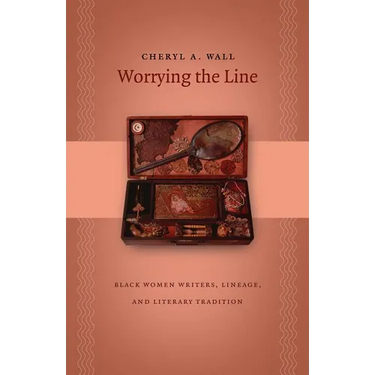

Worrying the Line: Black Women Writers, Lineage, and Literary Tradition - Paperback
 Worrying the Line: Black Women Writers, Lineage, and Literary Tradition - Paperback
$63.63
/
Worrying the Line: Black Women Writers, Lineage, and Literary Tradition - Paperback
$63.63
/

products.product.pickup_availability.unavailable

Your payment information is processed securely. We do not store credit card details nor have access to your credit card information.


by Cheryl a. Wall (Author)
For blues musicians, "worrying the line" is the technique of breaking up a phrase by changing pitch, adding a shout, or repeating words in order to emphasize, clarify, or subvert a moment in a song. Cheryl A. Wall applies this term to fiction and nonfiction writing by African American women in the twentieth century, demonstrating how these writers bring about similar changes in African American and American literary traditions.
Examining the works of Lucille Clifton, Gayl Jones, Audre Lorde, Paule Marshall, Toni Morrison, Gloria Naylor, and Alice Walker, Wall highlights ways in which these authors construct family genealogies, filling in the gaps with dreams, rituals, music, or images that forge a connection to family lost through slavery. For the black woman author, Wall contends, this method of revising and extending canonical forms provides the opportunity to comment on the literary past while also calling attention to the lingering historical effects of slavery. For the reader, Wall shows, the images and words combine to create a new kind of text that extends meanings of the line, both as lineage and as literary tradition.
Front Jacket
Wall applies the blues term "worrying the line" to describe the ways African American women writers reconstruct family genealogies in their fiction and nonfiction work through dreams, rituals, music, or images. Writers discussed include Toni Morrison, Alice Walker, Audre Lorde, Lucille Clifton, Paule Marshall, Gloria Naylor, and Gayl Jones.
Author Biography
Cheryl A. Wall is professor of English at Rutgers University and author of Women of the Harlem Renaissance. She has edited five books, including Changing Our Words: Essays on Criticism, Theory, and Writing by Black Women and, most recently, a critical casebook on Zora Neale Hurston's Their Eyes Were Watching God.

