
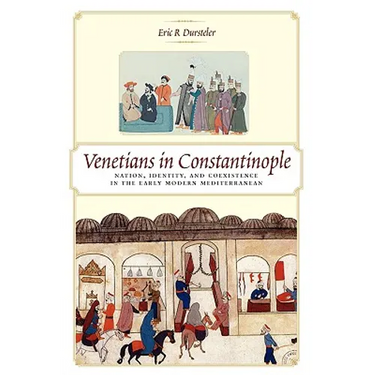

Venetians in Constantinople: Nation, Identity, and Coexistence in the Early Modern Mediterranean - Paperback
 Venetians in Constantinople: Nation, Identity, and Coexistence in the Early Modern Mediterranean - Paperback
$63.34
/
Venetians in Constantinople: Nation, Identity, and Coexistence in the Early Modern Mediterranean - Paperback
$63.34
/

products.product.pickup_availability.unavailable

Your payment information is processed securely. We do not store credit card details nor have access to your credit card information.


by Eric R. Dursteler (Author)
The introduction to this book is dazzling . . . The Venetian community in Constantinople provides an excellent site for exploration of issues of nation and identity . . . [Dursteler's] overall intention-to demonstrate cultural diversity in a place and era that has been commonly assumed to lack it-remains firmly at the fore, and he admirably fulfills his task.
Front Jacket
Moving beyond the clash of civilizations model that surveys the relationship between Islam and Christianity from a geopolitical perch, historian Eric R Dursteler focuses on a localized microcosm: the Venetian merchant and diplomatic community in Muslim Constantinople. Although dissonance and strife were certainly part of this relationship, he argues, coexistence and cooperation were more common.
While such factors as religion, culture, and political status could be integral elements in constructions of self and community, Dursteler finds that the fluidity and malleability of identity in the early modern world made coexistence among disparate cultures possible.
The introduction to this book is dazzling . . . The Venetian community in Constantinople provides an excellent site for exploration of issues of nation and identity . . . [Dursteler's] overall intention--to demonstrate cultural diversity in a place and era that has been commonly assumed to lack it--remains firmly at the fore, and he admirably fulfills his task.--American Historical Review
This is a boundary-busting book . . . Dursteler is to be commended for this insightful and gracefully written work that delivers a powerful message in brief compass, and will help change the way we consider European-Ottoman relations in the early modern era and perhaps West and non-West relations in our own.--Renaissance Quarterly
A significant contribution to new understandings of national, ethnic, and religious relations in the past, with clear explanations of common assumptions and frameworks for fluid identities and border-crossings.--Renaissance Studies
A rich body of interesting and colorful information . . . An important contribution to our understanding of the complex Mediterranean world of the early modern period.--Sixteenth Century Journal
Eric R Dursteler is an associate professor of history at Brigham Young University.
--David Jacoby "Sixteenth Century Journal"Back Jacket
Moving beyond the "clash of civilizations" model that surveys the relationship between Islam and Christianity from a geopolitical perch, historian Eric R Dursteler focuses on a localized microcosm: the Venetian merchant and diplomatic community in Muslim Constantinople. Although dissonance and strife were certainly part of this relationship, he argues, coexistence and cooperation were more common.
While such factors as religion, culture, and political status could be integral elements in constructions of self and community, Dursteler finds that the fluidity and malleability of identity in the early modern world made coexistence among disparate cultures possible.
"The introduction to this book is dazzling . . . The Venetian community in Constantinople provides an excellent site for exploration of issues of nation and identity . . . [Dursteler's] overall intention--to demonstrate cultural diversity in a place and era that has been commonly assumed to lack it--remains firmly at the fore, and he admirably fulfills his task."--American Historical Review
"This is a boundary-busting book . . . Dursteler is to be commended for this insightful and gracefully written work that delivers a powerful message in brief compass, and will help change the way we consider European-Ottoman relations in the early modern era and perhaps West and non-West relations in our own."--Renaissance Quarterly
"A significant contribution to new understandings of national, ethnic, and religious relations in the past, with clear explanations of common assumptions and frameworks for fluid identities and border-crossings."--Renaissance Studies
"A rich body of interesting and colorful information . . . An important contribution to our understanding of the complex Mediterranean world of the early modern period."--Sixteenth Century Journal
Eric R Dursteler is an associate professor of history at Brigham Young University.
Author Biography
Eric R Dursteler is an associate professor of history at Brigham Young University.

