
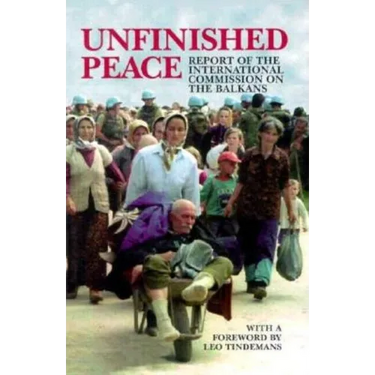

Unfinished Peace: Report of the International Commission on the Balkans - Paperback
 Unfinished Peace: Report of the International Commission on the Balkans - Paperback
$23.15
/
Unfinished Peace: Report of the International Commission on the Balkans - Paperback
$23.15
/

products.product.pickup_availability.unavailable

Your payment information is processed securely. We do not store credit card details nor have access to your credit card information.


by Carnegie Endwmnt Intl Peace (Author)
"...a superlative document-an incisive analysis of the rise of nationalism and its contribution to the death of Yugoslavia and to the wars that followed, an unflattering account of the West's failure to end the Bosnian war, a set of sensible recommendations for each country in the region, and imaginative proposals for the Balkans as a whole. Unfinished Peace, remarkably well written for a product of group-think, has a moral force which lifts its prescriptions far above the level of the normal policy institute paperback.... Unfinished Peace deserves to be read not just by Balkan experts, but by anyone concerned about the human condition and the human character under stress."- The New York Review of BooksDrawing on its extensive, high-level, and politically comprehensive discussions throughout the region, the Commission investigates the causes of the recent Balkan conflicts and provides an independent assessment of the European, American, and UN responses. It calls for a wide range of stabilizing measures-including proposals for the treatment of minorities, the promotion of democracy, and Balkan cooperation. To be effective, the Commission warns, such efforts must be reinforced by NATO's continuing and coherent military engagement.
The Commission was established in 1995 by the Aspen Institute Berlin and the Carnegie Endowment to provide an independent perspective on the region's continuing problems and to propose a concerted Western approach to long-term stability. The eminent leaders who served on the Commission were Leo Tindemans (Chairman), Lloyd Cutler, Bronislaw Geremek, John Roper, Theo Sommer, Simone Veil, and David Anderson (ex officio). Jacques Rupnik headed the Commission staff.
Back Jacket
The guns have fallen silent in the former Yugoslavia. But the Dayton truce has yet to become a lasting peace. Peace in the Balkans remain threatened not only by the possibility of a new war in Bosnia, but also by unresolved conflict in Kosova and Macedonia. At the end of the twentieth century, as at its beginning, the Balkans stand at a crossroads, facing the choice of being marginalized, or overcoming their problems and creating the conditions for their integration into the European mainstream. The stakes for the West are also high. Another war in the region might not threaten the West directly, but it would have a corrosive effect on Western unity. Stopping a new conflagration would require a large-scale Western intervention; another failure to intervene would raise more questions about what values the Western democracies are willing to defend. The International Commission on the Balkans was established in July 1995 by the Aspen Institute Berlin and the Carnegie Endowment for International Peace to provide an independent perspective on the region's continuing problems and to propose a concerted Western approach to long-term stability. The Commission - drawing on its extensive, high-level, and politically comprehensive discussions throughout the region - investigates the causes of the recent Balkan conflicts and provides an independent assessment of the European, American, and U.N. responses to them. It calls for a wide range of stabilizing measures - including proposals for the treatment of minorities, the promotion of democracy, and Balkan cooperation. To be effective, the Commission warns, such efforts must be reinforced by NATO's continuing and coherent military engagement.

