
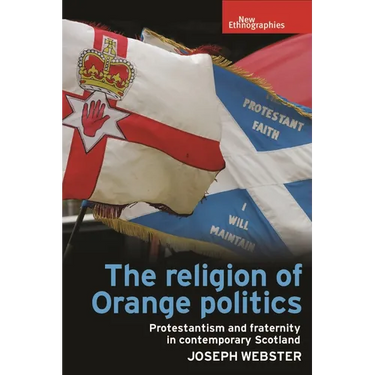

The Religion of Orange Politics: Protestantism and Fraternity in Contemporary Scotland - Paperback
 The Religion of Orange Politics: Protestantism and Fraternity in Contemporary Scotland - Paperback
$58.21
/
The Religion of Orange Politics: Protestantism and Fraternity in Contemporary Scotland - Paperback
$58.21
/

products.product.pickup_availability.unavailable

Your payment information is processed securely. We do not store credit card details nor have access to your credit card information.


by Joseph Webster (Author)
The religion of Orange politics offers an in-depth anthropological account of the Orange Order in Scotland. Based on ethnographic research collected before, during, and after the Scottish independence referendum, Joseph Webster details how Scotland's largest Protestant-only fraternity shapes the lives of its members and the communities in which they live. Within this Masonic-inspired 'society with secrets', Scottish Orangemen learn how transform themselves and their fellow brethren into what they regard to be ideal British citizens.
It is from this ethnographic context - framed by ritual initiations, loyalist marches, fraternal drinking, and constitutional campaigning - that the key questions of the book emerge: What is the relationship between fraternal love and sectarian hate? Can religiously motivated bigotry and exclusion be part of human experiences of 'The Good?' What does it mean to claim that one's religious community is utterly exceptional - a literal 'race apart'?Back Jacket
'Joseph Webster here confirms his reputation as an anthropologist of the hidden orders of power, prophecy, and secrecy that lie behind the everyday world. The religion of Orange politics is a timely reminder that religion, politics, and nationalism are intertwined in our identities in complex historic knots. Above all, it is a book about people, in all their flawed and noble humanity.'
David G. Robertson, The Open University
Sir Tom Devine, University of Edinburgh The religion of Orange politics offers an in-depth anthropological account of the Orange Order in Scotland. Based on ethnographic research collected before, during, and after the Scottish independence referendum, Joseph Webster details how Scotland's largest Protestant-only fraternity shapes the lives of its members and the communities in which they live. Within this Masonic-inspired 'society with secrets', Scottish Orangemen learn how to transform themselves and their fellow brethren into what they regard to be ideal British citizens. For many Scots-Orangemen, being British means being ultra-Protestant and ultra-unionist, but also frequently comes to be marked by pointedly anti-Catholic sentiments, and by a wider set of often deliberately sectarian political, cultural, and footballing loyalties. It is from this ethnographic context - framed by ritual initiations, loyalist marches, fraternal drinking, and constitutional campaigning - that the key questions of the book emerge: What is the relationship between fraternal love and sectarian hate? Can religiously motivated bigotry and exclusion be part of human experiences of 'The Good?' What does it mean to claim that one's religious community is utterly exceptional - a literal 'race apart'?
Author Biography
Joseph Webster is Assistant Professor in the Study of Religion at the University of Cambridge

