
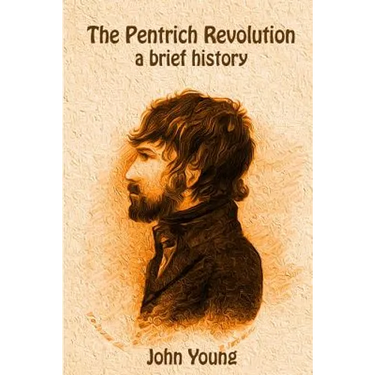

The Pentrich Revolution: a brief history - Paperback
 The Pentrich Revolution: a brief history - Paperback
$21.83
/
The Pentrich Revolution: a brief history - Paperback
$21.83
/

products.product.pickup_availability.unavailable

Your payment information is processed securely. We do not store credit card details nor have access to your credit card information.


by John Young (Author)
This 80 page book gives a brief, but full, history of the Pentrich Revolution. Illustrated with contemporary prints and modern photographs of key locations it tells the fascinating tale of how, on a wet night in June, 1817, a few hundred poorly-armed Derbyshire villagers set out to overthrow the British government. Inspired by the words of Tom Paine and driven by unemployment and hunger, they left the villages round Pentrich to join thousands of others wrongly supposed to be converging on Nottingham. After marching just thirteen miles, they were routed and scattered by a small detachment of dragoons; their rebellion was over. Most of the nation was disgusted to learn that Oliver, a spy employed by the Home Secretary Lord Sidmouth, had duped them into believing they were a small part of a nation-wide rising. Sadly for the Derbyshire rebels, they were on their own and many of them were to become the first 'commoners' to face the charge of High Treason. Their leader Jeremiah Brandreth and two others were hanged and then beheaded; these were the last ever public beheadings in England. Fourteen more were transported to Australia, never to return. More would have been punished except the government colluded with the prisoners' defence lawyers who did not present evidence of the machinations of the paid spy, Oliver. Jermiah Brandreth, also known as 'The Nottingham Captain' remains an enigmatic figure, even today. Widely portrayed by earlier writers as an unintelligent and brutal figure, recent research reveals him to have been a highly intelligent and courageous individual who bore imprisonment, trial and execution with a stoic dignity that impressed friend and foe alike. Illustrated with contemporary prints and including documents long locked away in Home office files, book offers a brief, readable account of the Derbyshire Rising and points the reader in the direction of further research. Suitably annotated, it gives a close-up view of a fascinating and significant event in British history that few people have even heard of. Fifteen years after The Pentrich Revolution, The Great Reform Act of 1832 began the process of giving many more people a voice in electing governments. Much of what the Derbyshire rebels demanded would be achieved within the next century. As the 200th anniversary approaches, the events of June 1817 are largely unknown and their charismatic hero, Jeremiah Brandreth, remains an enigma. This brief history is an attempt to bring the story of the last armed rebellion in England to the attention of a wider audience.
Author Biography
John Young FRSA studied at Oxford and Sheffield Universities and has had a life-long passionate interest in British social history. Born in Yorkshire, he has lived in Derbyshire for over forty years and first wrote about the Derbyshire Rising in 1981. His recently published book 'The Pentrich Revolution, a short history' gives the factual background to the events in his latest non-fiction novel, 'The Nottingham Captain'. John has been fascinated by the Pentrich Revolution for the past 35 years. Together with author and song-writer, Keith Jones, he co-wrote a set of original songs and toured a slideshow telling the story around social clubs in the early 1980s. Whilst at Spondon School, Derby, he wrote a play on the subject for students. This was televised in a Central TV programme directed by Norman Hull. 'The Pentrich Revolution' and its companion book 'The Nottingham Captain' have been written to celebrate the 200th anniversary of the Derbyshire Rising of 1817.'The Nottingham Captain' is a non-fiction novel that imagines the characters behind the events in The Pentrich Revolution history. A teacher for 30 years, John worked extensively in the Derbyshire Coalfield, was the Head of Shirebrook Community School, and Director of the Coalfields Education Action Zone. He also worked extensively in Derby supporting local schools. His office was across from the old Derby courthouse where the revolutionaries of 1817 were put on trial. Politically active from an early age he has written and performed songs about social justice for fifty years. He lives in Bolsover, Derbyshire from where he operates eebygum books and is planning to publish a number of titles in the next year.

