
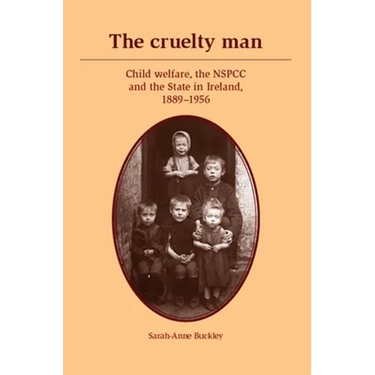

The Cruelty Man: Child Welfare, the Nspcc and the State in Ireland, 1889-1956 - Paperback
 The Cruelty Man: Child Welfare, the Nspcc and the State in Ireland, 1889-1956 - Paperback
$85.57
/
The Cruelty Man: Child Welfare, the Nspcc and the State in Ireland, 1889-1956 - Paperback
$85.57
/

products.product.pickup_availability.unavailable

Your payment information is processed securely. We do not store credit card details nor have access to your credit card information.


by Sarah-Anne Buckley (Author)
Recent debates surrounding children in State care, parental rights, and abuse in Ireland's industrial schools, concern issues that are rooted in the historical record. By examining the social problems addressed by philanthropists and child protection workers from the nineteenth century, we can begin to understand more about the treatment of children and the family today. In Ireland, the National Society for the Prevention of Cruelty to Children (NSPCC) was the principle organisation involved in investigating families and protecting children. The 'cruelty men', as NSPCC inspectors were known, acted as child protection workers and 'children's police'. This book looks at their history as well as the history of Ireland's industrial schools, poverty in Irish families, changing ideas around childhood and parenthood and the lives of children in Ireland from 1838 to 1970. It is a history filled with stories of real families, families often at the mercy of the State, the Catholic Church and voluntary organisations. It is a must-read for all with an interest in the Irish family and Irish childhood past and present.
Front Jacket
The cruelty man represents the first comprehensive account of the National Society for the Prevention of Cruelty to Children (NSPCC) in Ireland, from its foundation in 1889, to the passing of responsibilities to the Irish Society for the Prevention of Cruelty to Children (ISPCC) in 1956. In both Britain and Ireland, the NSPCC was at the forefront of the child protection movement, yet the history of the Society in Ireland has not been fully addressed. This book aims to fill this vacuum. It provides a study of the Society, while also utilising it as a vehicle to examine the treatment of poverty-stricken children and families by the State. More broadly, it contains a comprehensive history of child welfare from the introduction of the Poor Law in 1838 to the publication of the Kennedy Report in 1970. It addresses issues surrounding institutionalisation, welfare, family violence, compulsory education, child abuse and the role of charity in the provision of welfare. Based on research of the available records of the NSPCC archive, and court records, the text also explores changing concepts of childhood. It will appeal to both an academic and general audience, and will be essential to students of Irish social history, gender studies, social work and social policy. More generally, it will interest those observing recent reports into child abuse in State institutions and in particular the history of Ireland's industrial school system.
Back Jacket
The cruelty man represents the first comprehensive account of the National Society for the Prevention of Cruelty to Children (NSPCC) in Ireland, from its foundation in 1889, to the passing of responsibilities to the Irish Society for the Prevention of Cruelty to Children (ISPCC) in 1956. In both Britain and Ireland, the NSPCC was at the forefront of the child protection movement, yet the history of the Society in Ireland has not been fully addressed. This book aims to fill this vacuum.
It provides a study of the Society, while also utilising it as a vehicle to examine the treatment of poverty-stricken children and families by the State. More broadly, it contains a comprehensive history of child welfare from the introduction of the Poor Law in 1838 to the publication of the Kennedy Report in 1970. It addresses issues surrounding institutionalisation, welfare, family violence, compulsory education, child abuse and the role of charity in the provision of welfare. Based on research of the available records of the NSPCC archive, and court records, the text also explores changing concepts of childhood. It will appeal to both an academic and general audience, and will be essential to students of Irish social history, gender studies, social work and social policy. More generally, it will interest those observing recent reports into child abuse in State institutions and in particular the history of Ireland's industrial school system.Author Biography
Sarah-Anne Buckley is Lecturer in History in the National University of Ireland, Galway

