
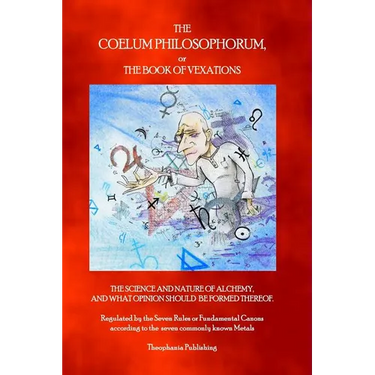

The Coelum Philosophorum: The Book of Vexations - Paperback
 The Coelum Philosophorum: The Book of Vexations - Paperback
$41.07
/
The Coelum Philosophorum: The Book of Vexations - Paperback
$41.07
/

products.product.pickup_availability.unavailable

Your payment information is processed securely. We do not store credit card details nor have access to your credit card information.


by Mark Illing (Illustrator), Philippus Theophrastus Paracelsus (Author)
Thank you for checking out this book by Theophania Publishing. We appreciate your business and look forward to serving you soon. We have thousands of titles available, and we invite you to search for us by name, contact us via our website, or download our most recent catalogues. THE SCIENCE AND NATURE OF ALCHEMY, AND WHAT OPINION SHOULD BE FORMED THEREOF. Regulated by the Seven Rules or Fundamental Canons according to the seven commonly known Metals
Author Biography
Paracelsus (born Phillippus Aureolus Theophrastus Bombastus von Hohenheim, 11 November or 17 December 1493 in Einsiedeln, Switzerland - 24 September 1541 in Salzburg, Austria) was a Renaissance physician, botanist, alchemist, astrologer, and general occultist. "Paracelsus", meaning "equal to or greater than Celsus", refers to the Roman encyclopedist Aulus Cornelius Celsus from the first century known for his tract on medicine. Paracelsus rejected the magic theories of Agrippa and Flamel in his Archidoxes of Magic. Astrology was a very important part of Paracelsus' medicine, and he was a practicing astrologer -- as were many of the university-trained physicians working at this time in Europe. Paracelsus devoted several sections in his writings to the construction of astrological talismans for curing disease, providing talismans for various maladies as well as talismans for each sign of the Zodiac. He also invented an alphabet called the Alphabet of the Magi, for engraving angelic names upon talismans. He died at the age of 48 and his remains were buried according to his wishes in the cemetery at the church of St Sebastian in Salzburg. His motto was "Alterius non sit qui suus esse potest" which means "Let no man that can belong to himself be of another".

