
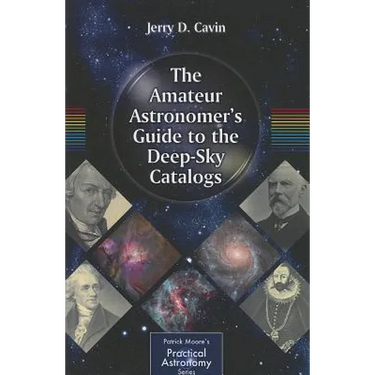

The Amateur Astronomer's Guide to the Deep-Sky Catalogs - Paperback
 The Amateur Astronomer's Guide to the Deep-Sky Catalogs - Paperback
$55.58
/
The Amateur Astronomer's Guide to the Deep-Sky Catalogs - Paperback
$55.58
/

products.product.pickup_availability.unavailable

Your payment information is processed securely. We do not store credit card details nor have access to your credit card information.


by Jerry D. Cavin (Author)
Every amateur astronomer has at least heard of the many different catalogs of deep-sky objects; the most well known are the Messier, the Caldwell, the Herschel, and the NGC. All of these catalogs are, in general, readily available, but very few amateur observers are in a position to choose the best catalog for their particular deep-sky observing program, know how to use the catalog, or even realize just how many there are out there!
The Amateur Astronomer's Guide to the Deep-sky Catalogs is a single compilation of the historical and modern astronomical deep-sky catalogs. It discusses their origins, compares what's in them, explains how to interpret the data they contain, and even outlines how readers can create suitable 'custom' catalogs for their own use. The last section provides a set of three deep-sky catalogs created by the author, for observers of different levels of experience, from newcomer to expert.
Back Jacket
All of us familiar with astronomy know of Charles Messier and his early work on creating a catalog of celestial objects. Did you know that Messier was compiling a list of objects to avoid when searching the skies? He was a comet hunter, and he wanted to not mistake other things for comets.
Other lists and catalogs followed this, and many, including Messier's, have become popular with amateur astronomers who see it as a challenge to find everything on the list or as a guide on what to see when they look through their telescopes or binoculars.
In this "catalog of catalogs," the author introduces the figures behind the most famous of the star catalogs and includes the catalog listings as well. Thus here, all in one book, is your complete guide to the heavenly bodies - including constellations, galaxies, nebulae, supernova remnants, and much more - that most people seek to see when they observe the night sky. Here are enough challenges for a lifetime of exciting viewing!
Author Biography
Jerry Cavin first turned to amateur astronomy while growing up under the dark skies of Iowa. After leaving the farm, he completed a BS in Computer Science with a minor in Electrical Engineering at the University of Nebraska at Omaha. He worked for 10 years as the Lead Software Engineer at the Control Data Corporation specializing in real time control systems. After getting married he moved to Austin, Texas and spent over 15 years at the University of Texas at Austin working as a Research Scientist Associate on electronic warfare systems.
He is currently working as a Systems Engineer at Overwatch System and will be completing his second MSc degree in Astronomy at the Swinburne Astronomy Online, via the Centre for Astrophysics and Supercomputing in Melbourne, Australia.

