
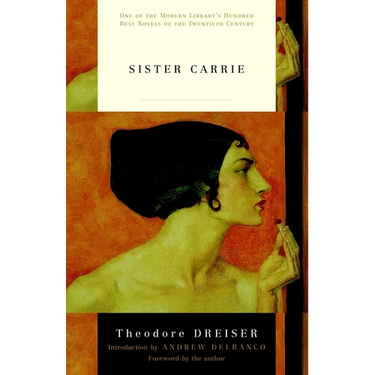


Sister Carrie - Paperback
 Sister Carrie - Paperback
$29.00
/
Sister Carrie - Paperback
$29.00
/

products.product.pickup_availability.unavailable

Your payment information is processed securely. We do not store credit card details nor have access to your credit card information.


by Theodore Dreiser (Author), Andrew Delbanco (Introduction by)
Selected by the Modern Library as one of the 100 best novels of all time
"Theodore Dreiser is a man who, with the passage of time, is bound to loom larger and larger in the awakening aesthetic consciousness of America. Among all of our prose writers he is one of the few men of whom it may be said that he has . . . never been a trickster. If there is a modern movement in American prose writing, a movement toward greater courage and fidelity to life in writing, Theodore Dreiser is the pioneer and the hero of the movement."--Sherwood Anderson Long before she was seduced by the cautious and ordinary man whose life she would unravel with no malice and only intermittent interest, the young Carrie Meeber was seduced by the promise of the city--its vitality and reckless possibility, the thrill of material luxury, and the spectacle of power and industry. Banned on publication for its questionable morals, Sister Carrie is the great American novel of seduction, a masterpiece of insight into appetite and innocence. "Such a novel as Sister Carrie stands quite outside the brief traffic of the customary stage. It leaves behind an inescapable impression of bigness, of epic sweep and dignity. It is not a mere story, not a novel in the customary American meaning of the word; it is at once a psalm of life and a criticism of life. . . . [Dreiser's] aim is not merely to tell a tale; his aim is to show the vast ebb and flow of forces which sway and condition human destiny. The thing he seeks to do is to stir, to awaken, to move. One does not arise from such a book as Sister Carrie with a smirk of satisfaction; one leaves it infinitely touched."--H. L. MenckenFront Jacket
Theodore Dreiser is a man who, with the passage of time, is bound to loom larger and larger in the awakening aesthetic consciousness of America. Among all of our prose writers he is one of the few men of whom it may be said that he has . . . never been a trickster. If there is a modern movement in American prose writing, a movement toward greater courage and fidelity to life in writing, Theodore Dreiser is the pioneer and the hero of the movement.--Sherwood Anderson
Long before she was seduced by the cautious and ordinary man whose life she would unravel with no malice and only intermittent interest, the young Carrie Meeber was seduced by the promise of the city--its vitality and reckless possibility, the thrill of material luxury, and the spectacle of power and industry. Banned on publication for its questionable morals, Sister Carrie is the great American novel of seduction, a masterpiece of insight into appetite and innocence.
"Such a novel as Sister Carrie stands quite outside the brief traffic of the customary stage. It leaves behind an inescapable impression of bigness, of epic sweep and dignity. It is not a mere story, not a novel in the customary American meaning of the word; it is at once a psalm of life and a criticism of life. . . . [Dreiser's] aim is not merely to tell a tale; his aim is to show the vast ebb and flow of forces which sway and condition human destiny. The thing he seeks to do is to stir, to awaken, to move. One does not arise from such a book as Sister Carrie with a smirk of satisfaction; one leaves it infinitely touched."--H. L. Mencken
Author Biography
Theodore Dreiser, one of the principal exponents of naturalism in American literature, was born in Terre Haute, Indiana, on August 27, 1871, into a large family of German ancestry. He endured a rootless upbringing as his parents moved their ten children to different towns in search of employment. Along the way Dreiser received an erratic education in various parochial and public schools; he read voraciously from an early age and was largely self-taught. He began his writing career in 1892 as a cub reporter for the Chicago Daily Globe, an experience he recalled in A Book About Myself (1922; republished as Newspaper Days in 1931), and later wrote for the St. Louis Globe-Democrat and the Pittsburgh Dispatch. His years as a journalist proved instrumental in developing the exhaustively detailed style that is the hallmark of his fiction. In 1894 Dreiser arrived in New York City and became editor of Ev'ry Month, a moderately successful literary magazine. Encouraged by a publishing colleague, he turned out short stories and entertained thoughts about writing a novel.

