
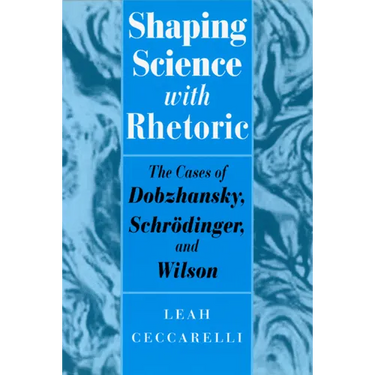

Shaping Science with Rhetoric: The Cases of Dobzhansky, Schrodinger, and Wilson - Paperback
 Shaping Science with Rhetoric: The Cases of Dobzhansky, Schrodinger, and Wilson - Paperback
$73.60
/
Shaping Science with Rhetoric: The Cases of Dobzhansky, Schrodinger, and Wilson - Paperback
$73.60
/

products.product.pickup_availability.unavailable

Your payment information is processed securely. We do not store credit card details nor have access to your credit card information.


by Leah Ceccarelli (Author)
How do scientists persuade colleagues from diverse fields to cross the disciplinary divide, risking their careers in new interdisciplinary research programs? Why do some attempts to inspire such research win widespread acclaim and support, while others do not?
In Shaping Science with Rhetoric, Leah Ceccarelli addresses such questions through close readings of three scientific monographs in their historical contexts-Theodosius Dobzhansky's Genetics and the Origin of Species (1937), which inspired the "modern synthesis" of evolutionary biology; Erwin Schrödinger's What Is Life? (1944), which catalyzed the field of molecular biology; and Edward O. Wilson's Consilience (1998), a so far not entirely successful attempt to unite the social and biological sciences. She examines the rhetorical strategies used in each book and evaluates which worked best, based on the reviews and scientific papers that followed in their wake. Ceccarelli's work will be important for anyone interested in how interdisciplinary fields are formed, from historians and rhetoricians of science to scientists themselves.Front Jacket
How do scientists persuade colleagues from diverse fields to cross the disciplinary divide, risking their careers in new interdisciplinary research programs? Why do some attempts to inspire such research win widespread acclaim and support, while others do not?
In "Shaping Science with Rhetoric, " Leah Ceccarelli addresses such questions through close readings of three scientific monographs in their historical contexts Theodosius Dobzhansky's "Genetics and the Origin of Species" (1937), which inspired the "modern synthesis" of evolutionary biology; Erwin Schrodinger's "What Is Life?" (1944), which catalyzed the field of molecular biology; and Edward O. Wilson's "Consilience" (1998), a so far not entirely successful attempt to unite the social and biological sciences. She examines the rhetorical strategies used in each book and evaluates which worked best, based on the reviews and scientific papers that followed in their wake.
Ceccarelli's work will be important for anyone interested in how interdisciplinary fields are formed, from historians and rhetoricians of science to scientists themselves."
Back Jacket
How do scientists persuade colleagues from diverse fields to cross the disciplinary divide, risking their careers in new interdisciplinary research programs? Why do some attempts to inspire such research win widespread acclaim and support, while others do not?
In Shaping Science with Rhetoric, Leah Ceccarelli addresses such questions through close readings of three scientific monographs in their historical contexts--Theodosius Dobzhansky's Genetics and the Origin of Species (1937), which inspired the "modern synthesis" of evolutionary biology; Erwin Schrödinger's What Is Life? (1944), which catalyzed the field of molecular biology; and Edward O. Wilson's Consilience (1998), a so far not entirely successful attempt to unite the social and biological sciences. She examines the rhetorical strategies used in each book and evaluates which worked best, based on the reviews and scientific papers that followed in their wake. Ceccarelli's work will be important for anyone interested in how interdisciplinary fields are formed, from historians and rhetoricians of science to scientists themselves.Author Biography
Leah Ceccarelli is an assistant professor in the Department of Speech Communication at the University of Washington, Seattle.

