

Seabees, From Omaha To Okinawa: A Sequel to Can Do! - Paperback
 Seabees, From Omaha To Okinawa: A Sequel to Can Do! - Paperback
$30.63
/
Seabees, From Omaha To Okinawa: A Sequel to Can Do! - Paperback
$30.63
/

products.product.pickup_availability.unavailable

Your payment information is processed securely. We do not store credit card details nor have access to your credit card information.


by William Bradford Huie (Author)
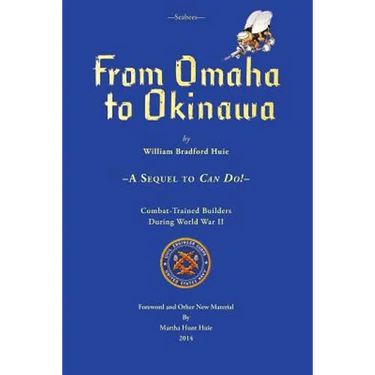
William Bradford Huie, joined the U.S. Navy in 1943. He was commission as a public relations officer in the little-known Civil Engineer Corps' Construction Battalions--the Seabees. The following year he published "Can Do!", an account of their landing with the Marines at Guadalcanal and Wake Island, Sicily and Salerno. This book is a sequel to "Can Do!" and continues the saga of the combat trained civilian plumbers, carpenters, heavy equipment operators, wharf builders, and civil engineers who served in the U.S. Navy construction battalions. The story begins with Iwo Jima when the Seabees braved concentrated enemy fire to rig floating causeways, blow up wrecked landing craft, and to build the desperately needed airstrips while under enemy fire. Huie also describes the Seabees on D-Day at Omaha Beach, where they manned fifteen hundred vehicles during the first wave of landings at Normandy. He provides the details of the creation and testing of various pier-heads, floating steel bridges, and "Rhino" ferries. He also tells colorful stories of moon-shining, brawling, and carousing along with compassionate stories of the children in the prisoner of war camps.
Author Biography
William Bradford "Bill" Huie (November 13, 1910 - November 20, 1986) was an American journalist, editor, publisher, television interviewer, screenwriter, lecturer, and novelist. Born in Hartselle, Alabama, Huie was the son of John Bradford and Margaret Lois Brindley Huie, and was the eldest of three children. He attended Morgan County High School and graduated as class valedictorian. He then attended the University of Alabama, graduating Phi Beta Kappa in 1930. From 1932 to 1936, Huie worked for the newspaper The Birmingham Post. In 1934, he married his grammar school sweetheart, Ruth Puckett. In late 1938, Huie was in Los Angeles and took it upon himself to work as an undercover reporter to gather information on gangster Benjamin "Bugsy" Siegel. He reported on his experiences in the December 1950 edition of the American Mercury.During World War II, he served in the United States Navy, for a time as aide to Vice Admiral Ben Moreell of the famous Seabees. While chronicling the wartime activity of the Seabees, Lieutenant Huie had special permission to continue his own writing projects, both fiction and nonfiction, dealing primarily with the war. His Navy experiences, including his participation in D-Day, would become the basis for his 1959 novel The Americanization of Emily, adapted into the 1964 film of the same name starring James Garner and Julie Andrews. Both Garnerand Andrews consider it the personal favorite of their films. Released from the Navy in 1945, Huie went immediately to the Pacific theater as a war correspondent. His experiences at Iwo Jima became the basis for the nonfiction work "The Hero of Iwo Jima," published in The Hero of Iwo Jima and Other Stories in 1962, the tragic story of flag-raiser Ira Hayes. Huie's account was developed into the 1961 film The Outsider with Tony Curtis. His experiences in Hawaii during the war became the basis for the novel The Revolt of Mamie Stover (1951), which was developed into the 1956 film of the same name starring Jane Russell.

