
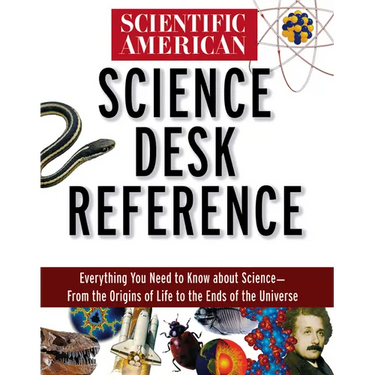

Scientific American Science Desk Reference - Hardcover
 Scientific American Science Desk Reference - Hardcover
$71.75
/
Scientific American Science Desk Reference - Hardcover
$71.75
/

products.product.pickup_availability.unavailable

Your payment information is processed securely. We do not store credit card details nor have access to your credit card information.


by The Editors of Scientific American (Editor), Scientific American (Compiled by)
Who names newly discovered planets? What exactly are black holes? Where are there the most earthquakes? When did the first Homo sapiens walk the earth? Why is the night sky dark? How does the fluoride in toothpaste prevent cavities? Since 1845, Scientific American has answered questions and provided the best information available in all areas of science. Now, Scientific American is proud to present an accessible, one-volume reference covering all the sciences. Whether you want to examine the tiniest microbes, the properties of the earth's core, or the farthest reaches of space, this handy desk reference is the resource to turn to for the answers you need. * Over 500 biographies of key science figures * Thousands of glossary terms * Hundreds of useful Web sites * Tables, charts, diagrams, and illustrations * Sidebars featuring fascinating facts, mnemonic aids, and quizzes * Essays exploring ideas in-depth
Front Jacket
Scientific American Science Desk Reference The ultimate in reference from the authority on science and technology For over 150 years, Scientific American has been explaining science to the public, developing a reputation for conveying complex scientific information in a way that inquisitive nonscientists can understand. Now Scientific American presents this one-volume, easy-to-use reference to the exciting and ever-changing world of science and technology. In sixteen sections, Scientific American Science Desk Reference covers everything from the age of the earth to the dimensions of space, from evolutionary theory and the study of fossils to the latest in genetic research. Each scientific field is explored through an overview of key topics, a chronology of discoveries, and a list of further reading. Over 500 biographies of key science figures give an idea of the vast human effort scientific endeavor requires. Thousands of glossary terms and hundreds of useful Web sites are listed. Also included are hundreds of visual elements, including tables, charts, diagrams, and illustrations. And hundreds of sidebars feature fascinating facts, mnemonic aids, and quizzes to help you grasp the concepts discussed. Along with a careful exploration of the basics of science, the book also includes essays from knowledgeable contributors that provide engaging commentary on various fields. For instance, Tony Jones discusses the paradigm-shaking discoveries of planets in our solar system, Edward Young contemplates differing theories on how the dinosaurs became extinct, and Chris Stringer explores competing theories of evolution. Whether you're a student, or simply an enthusiast, Scientific American Science Desk Reference has all the compelling facts you need to explore the world around you.
Back Jacket
Who names newly discovered planets? What exactly are black holes? Where are there the most earthquakes? When did the first Homo sapiens walk the earth? Why is the night sky dark? How does the fluoride in toothpaste prevent cavities? Since 1845, Scientific American has answered questions and provided the best information available in all areas of science. Now, Scientific American is proud to present an accessible, one-volume reference covering all the sciences. Whether you want to examine the tiniest microbes, the properties of the earth's core, or the farthest reaches of space, this handy desk reference is the resource to turn to for the answers you need. - Over 500 biographies of key science figures - Thousands of glossary terms - Hundreds of useful Web sites - Tables, charts, diagrams, and illustrations - Sidebars featuring fascinating facts, mnemonic aids, and quizzes - Essays exploring ideas in-depth
Author Biography
Scientific American is one of the world's leading science and technology publications. In English, it reaches more than 3 million people around the world by subscription, newsstands, and online.

