
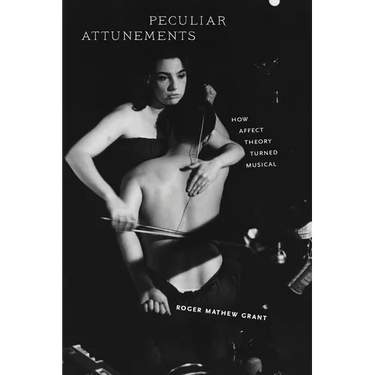

Peculiar Attunements: How Affect Theory Turned Musical - Paperback
 Peculiar Attunements: How Affect Theory Turned Musical - Paperback
$68.56
/
Peculiar Attunements: How Affect Theory Turned Musical - Paperback
$68.56
/

products.product.pickup_availability.unavailable

Your payment information is processed securely. We do not store credit card details nor have access to your credit card information.


by Roger Mathew Grant (Author)
Peculiar Attunements places the recent turn to affect into conversation with a parallel movement in European music theory of the eighteenth century. During that time the affects--or passions, as they were also called--formed a vital component of a mimetic model of the arts. Eighteenth-century critics held that artworks imitated or copied the natural world in order to produce copies of the affects in their beholders. But music caused a problem for such theories, since it wasn't apparent that musical tones could imitate anything with any dependability, beyond the rare thunderclap or birdcall.
Struggling to articulate how it was that music managed to move its auditors without imitation, certain theorists developed a new affect theory crafted especially for music, postulating that music's physical materiality as sound vibrated the nerves of listeners and attuned them to the affects through sympathetic resonance. This was a theory of affective attunement that bypassed the entire structure of representation, offering a non-discursive, corporeal alternative. It is a pendant to contemporary theories of affect, and one from which they have much to learn. Inflecting our current intellectual moment through eighteenth-century music theory and aesthetics, this book offers a reassessment of affect theory's common systems and processes. It offers a new way of thinking through affect dialectically, drawing attention to patterns and problems in affect theory that we have been given to repeating. Finally, taking a cue from eighteenth-century theory, it gives renewed attention to the objects that generate affects in subjects.Back Jacket
"Affect theorists and musicologists have been waiting for a book like this for a very long time, and we are lucky to get it from a thinker as clear-sighted as Grant. With its unparalleled lucidity, and lively, nimble prose, Peculiar Attunements promises to be an instant classic in the study of affect and emotion."--Sianne Ngai, University of Chicago
"Why is contemporary affect theory suffused with words like resonance, reverberation, tuning, vibration--language that conjures up music? Roger Grant, in posing that question, mounts a formidable and extraordinarily clear-headed critique of affect theory, while at the same time identifying and then demystifying its strange affinities with eighteenth-century theories about music's power. This rich theoretical harvest becomes the framework for Grant's novel take on mimesis and meaning in eighteenth-century instrumental music and opera, in a book that reimagines this repertory in ways that are subtle, surprising, revelatory--a tour-de-force."--Carolyn Abbate, Harvard University Peculiar Attunements places the recent turn to affect into conversation with a parallel movement in European music theory of the eighteenth century. During that time the affects formed a vital component of a mimetic model of the arts. Eighteenth-century critics held that artworks imitated or copied the natural world in order to produce copies of the affects in their beholders. But music caused a problem for such theories, since--apart from the rare thunderclap or birdcall--it wasn't apparent that musical tones could imitate anything with any dependability. As a result, eighteenth-century thinkers postulated that music's physical materiality as sound vibrated the nerves of listeners and attuned them to the affects through sympathetic resonance. This theory is a pendant to our contemporary theories of affect, and one from which they have much to learn. Inflecting our current intellectual moment through eighteenth-century music theory and aesthetics, Grant offers a reassessment of affect theory's common systems and processes. Roger Mathew Grant is Associate Professor of Music at Wesleyan University. He is the author of Beating Time and Measuring Music in the Early Modern Era (Oxford), which won the 2016 Society for Music Theory Emerging Scholar Award.Author Biography
Roger Mathew Grant is Associate Professor of Music at Wesleyan University. His first book, Beating Time and Measuring Music in the Early Modern Era (Oxford, 2014) won the Emerging Scholar Award from the Society for Music Theory.

