
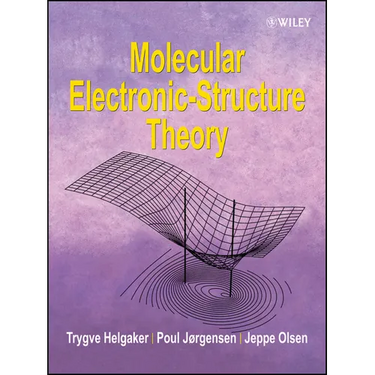

Molecular Electronic-Structure Theory - Paperback
 Molecular Electronic-Structure Theory - Paperback
$169.65
/
Molecular Electronic-Structure Theory - Paperback
$169.65
/

products.product.pickup_availability.unavailable

Your payment information is processed securely. We do not store credit card details nor have access to your credit card information.


by Trygve Helgaker (Author), Poul Jorgensen (Author), Jeppe Olsen (Author)
Spätestens seit der Entwicklung leistungsfähiger Computerprogramme interessieren sich auch Nichtspezialisten für die theoretischen Grundlagen quantenchemischer Berechnungen. Dieses Buch bietet einen umfassenden, modernen Überblick über die zweite Quantisierung, Wellenfunktionen, Basissätze und Integrale; alle gängigen Verfahren werden berücksichtigt (Hartree-Fock-Theorie, CI, MCSCF, Coupled Clusters, Störungstheorie). Ausführlich diskutiert wird auch die Kalibration der Methoden. (03/00)
Back Jacket
Ab initio quantum chemistry has emerged as an important tool in chemical research and is applied to a wide variety of problems in chemistry and molecular physics. Recent developments of computational methods have enabled previously intractable chemical problems to be solved using rigorous quantum-mechanical methods.
This is the first comprehensive up-to-date and technical work to cover all the important aspects of modern molecular electronic-structure theory. Topics covered in the book include:
- Second quantization with spin adaptation
- Gaussian basis sets and molecular-integral evaluation
- Hartree-Fock theory
- Configuration-interaction and multi-configurational self-consistent theory
- Coupled-cluster theory for ground and excited states
- Perturbation theory for single- and multi-configuration states
- Linear-scaling techniques and the fast multiple method
- Explicitly correlated wave functions
- Basis-set convergence and extrapolation
- Calibration and benchmarking of computational methods, with applications to molecular equilibrium structures, atomization energies and reaction enthalpies.
Molecular Electronic-Structure Theory makes extensive use of numerical examples, designed to illustrate the strengths and weaknesses of each method treated. In addition, statements about the usefulness and deficiencies of the various methods are supported by actual examples, not just model calculations. Problems and exercises are provided at the end of each chapter, complete with hints and solutions.
This book is a must for researchers in the field of quantum chemistry as well as for nonspecialists who wish to acquire a thorough understanding of ab initio molecular electronic-structure theory and its applications to problems in chemistry and physics. It is also highly recommended for the teaching of graduates and advanced undergraduates.
Author Biography
Trygve Helgaker, Department of Chemistry, University of Oslo, Norway.
Poul Jorgensen and Jeppe Olsen Department of Chemistry, University of Aarhus, Denmark.

