
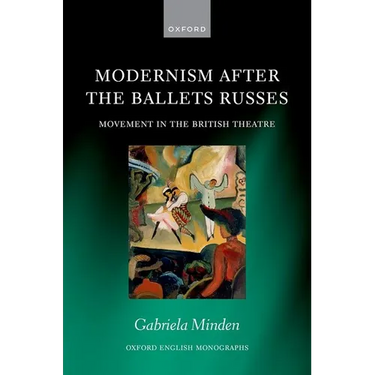

Modernism After the Ballets Russes: Movement in the British Theatre - Hardcover
 Modernism After the Ballets Russes: Movement in the British Theatre - Hardcover
$178.00
/
Modernism After the Ballets Russes: Movement in the British Theatre - Hardcover
$178.00
/

products.product.pickup_availability.unavailable

Your payment information is processed securely. We do not store credit card details nor have access to your credit card information.


by Gabriela Minden (Author)
Serge Diaghilev's Ballets Russes holds a renowned position in the history of modernism across various arts. The company's daring productions brought together leading artists working in diverse fields - from Igor Stravinsky to Pablo Picasso, from Bronislava Nijinska to Coco Chanel - redefining the possibilities of artistic collaboration and shaping the trajectories of dance, music, fashion, and the visual arts. But what of the Ballets Russes's role in the text-based theatre? Despite the intrinsic link between dance and theatre as performance arts, the company's contributions to dramatic literature and dramaturgy have remained surprisingly elusive. This book establishes the Ballets Russes as a powerful force in the development of modernist theatre in Britain, revealing how the company's avant-garde repertoire inspired the creation of new composition strategies and performance techniques that privileged the immediacy of expression offered by the moving, dancing body.
Modernism After the Ballets Russes examines the philosophical conditions of early twentieth-century Britain's theatrical landscape, marked by growing interest in Nietzschean interpretations of classical drama and Wagnerian notions of the Gesamtkunstwerk, to illuminate the allure of the Ballets Russes's re-centring of dance as the foundation of theatre art. It shows that Diaghilev ballets provided new ways of thinking about the relationship between the literary and embodied aspects of dramatic performance, fueling collaborations between eminent dramatists and theatre practitioners - Harley Granville Barker, J. M. Barrie, Terence Gray, and W. H. Auden - and lesser-known choreographers: Cecil Sharp, Tamara Karsavina, Ninette de Valois, and Rupert Doone. Through the prism of the Ballets Russes, this group of artists crafted distinctive new theatrical forms, including a whimsical terpsichorean fantasia and a politically subversive poetic dramatic satire, as well as new methods of staging Shakespearean comedy and Attic tragedy. Together, this book contends, these literary and dramaturgical innovations represent a previously neglected strand of modernism: one that saw the dramatic power of the moving body expand the expressive resources of the period's theatrical arts.Author Biography
Gabriela Minden, Leverhulme Early Career Fellow, Department of English Studies, Durham University
Gabriela Minden is a Leverhulme Early Career Fellow in the Department of English Studies at Durham University. She completed her BA in English Literature at Barnard College, Columbia University, where she received the ES Carrigan Prize for graduate study in English. She then read for MSt and DPhil degrees at the University of Oxford, where she was awarded the 2022 Swapna Dev Memorial Book Prize, for the best DPhil thesis examined in the Oxford English Faculty. Before joining Durham, she was a lecturer at Cardiff University.
