
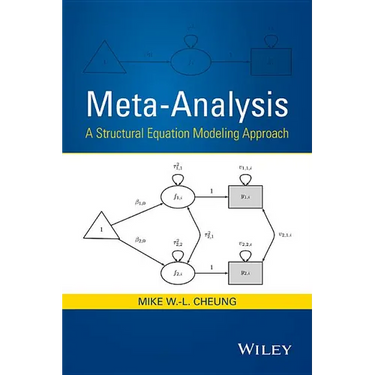

Meta-Analysis: A Structural Equation Modeling Approach - Hardcover
 Meta-Analysis: A Structural Equation Modeling Approach - Hardcover
$126.45
/
Meta-Analysis: A Structural Equation Modeling Approach - Hardcover
$126.45
/

products.product.pickup_availability.unavailable

Your payment information is processed securely. We do not store credit card details nor have access to your credit card information.


by Mike W. -L Cheung (Author)
Presents a novel approach to conducting meta-analysis using structural equation modeling.
Structural equation modeling (SEM) and meta-analysis are two powerful statistical methods in the educational, social, behavioral, and medical sciences. They are often treated as two unrelated topics in the literature. This book presents a unified framework on analyzing meta-analytic data within the SEM framework, and illustrates how to conduct meta-analysis using the metaSEM package in the R statistical environment.
Meta-Analysis: A Structural Equation Modeling Approach begins by introducing the importance of SEM and meta-analysis in answering research questions. Key ideas in meta-analysis and SEM are briefly reviewed, and various meta-analytic models are then introduced and linked to the SEM framework. Fixed-, random-, and mixed-effects models in univariate and multivariate meta-analyses, three-level meta-analysis, and meta-analytic structural equation modeling, are introduced. Advanced topics, such as using restricted maximum likelihood estimation method and handling missing covariates, are also covered. Readers will learn a single framework to apply both meta-analysis and SEM. Examples in R and in Mplus are included.
This book will be a valuable resource for statistical and academic researchers and graduate students carrying out meta-analyses, and will also be useful to researchers and statisticians using SEM in biostatistics. Basic knowledge of either SEM or meta-analysis will be helpful in understanding the materials in this book.
Back Jacket
Presents a novel approach to conducting meta-analysis using structural equation modeling.
Structural equation modeling (SEM) and meta-analysis are two powerful statistical methods in the educational, social, behavioral, and medical sciences. They are often treated as two unrelated topics in the literature. This book presents a unified framework on analyzing meta-analytic data within the SEM framework, and illustrates how to conduct meta-analysis using the metaSEM package in the R statistical environment.
Meta-Analysis: A Structural Equation Modeling Approach begins by introducing the importance of SEM and meta-analysis in answering research questions. Key ideas in meta-analysis and SEM are briefly reviewed, and various meta-analytic models are then introduced and linked to the SEM framework. Fixed-, random-, and mixed-effects models in univariate and multivariate meta-analyses, three-level meta-analysis, and meta-analytic structural equation modeling, are introduced. Advanced topics, such as using restricted maximum likelihood estimation method and handling missing covariates, are also covered. Readers will learn a single framework to apply both meta-analysis and SEM. Examples in R and some of the analyses in Mplus and LISREL are included.
This book will be a valuable resource for statistical and academic researchers and graduate students carrying out meta-analyses, and will also be useful to researchers and statisticians using SEM in biostatistics. Basic knowledge of either SEM or meta-analysis will be helpful in understanding the materials in this book.
Author Biography
Mike W.-L. Cheung, National University of Singapore, Singapore

