
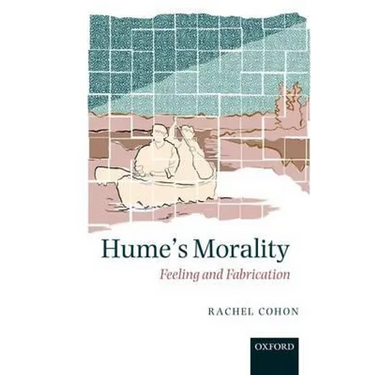

Hume's Morality: Feeling and Fabrication - Paperback
 Hume's Morality: Feeling and Fabrication - Paperback
$107.89
/
Hume's Morality: Feeling and Fabrication - Paperback
$107.89
/

products.product.pickup_availability.unavailable

Your payment information is processed securely. We do not store credit card details nor have access to your credit card information.


by Cohon (Author), Rachel Cohon (Author), David Edmonds (Author)
Rachel Cohon offers an original interpretation of the moral philosophy of David Hume, focusing on two areas. Firstly, his metaethics. Cohon reinterprets Hume's claim that moral distinctions are not derived from reason and explains why he makes it. She finds that Hume did not actually hold three "Humean" claims: 1) that beliefs alone cannot move us to act, 2) that evaluative propositions cannot be validly inferred from purely factual propositions, or 3) that moral judgments lack truth value. According to Hume, human beings discern moral virtues and vices by means of feeling or emotion in a way rather like sensing; but this also gives the moral judge a truth-apt idea of a virtue or vice as a felt property. Secondly, Cohon examines the artificial virtues. Hume says that although many virtues are refinements of natural human tendencies, others (such as honesty) are constructed by social convention to make cooperation possible; and some of these generate paradoxes. She argues that Hume sees these traits as prosthetic virtues that compensate for deficiencies in human nature. However, their true status clashes with our common-sense conception of a virtue, and so has been concealed, giving rise to the paradoxes.
Author Biography
Rachel Cohon is Associate Professor of Philosophy at the University at Albany, State University of New York. She is the editor of Hume: Moral and Political Philosophy (Dartmouth/Ashgate, 2001) and author of a number of articles about Hume's moral philosophy and about the relation of between morality and reasons, including "Hume on Promises and the Peculiar Act of the Mind," (Journal of the History of Philosophy, 2006) and "The Roots of Reasons" (Philosophical Review, 2000).

