
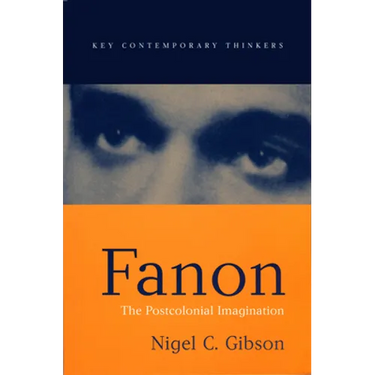

Fanon: An Historical Introduction - Hardcover
 Fanon: An Historical Introduction - Hardcover
$120.33
/
Fanon: An Historical Introduction - Hardcover
$120.33
/

products.product.pickup_availability.unavailable

Your payment information is processed securely. We do not store credit card details nor have access to your credit card information.


by Nigel C. Gibson (Author)
Frantz Fanon was a French psychiatrist turned Algerian revolutionary of Martinican origin, and one of the most important and controversial thinkers of the postwar period. A veritable "intellect on fire," Fanon was a radical thinker with original theories on race, revolution, violence, identity and agency.
This book is an excellent introduction to the ideas and legacy of Fanon. Gibson explores him as a truly complex character in the context of his time and beyond. He argues that for Fanon, theory has a practical task to help change the world. Thus Fanon's "untidy dialectic," Gibson contends, is a philosophy of liberation that includes cultural and historical issues and visions of a future society. In a profoundly political sense, Gibson asks us to reevaluate Fanon's contribution as a critic of modernity and reassess in a new light notions of consciousness, humanism, and social change.
This is a fascinating study that will interest undergraduates and above in postcolonial studies, literary theory, cultural studies, sociology, politics, and social and political theory, as well as general readers.
Back Jacket
Frantz Fanon was a French psychiatrist turned Algerian revolutionary of Martinican origin, and one of the most important and controversial thinkers of the postwar period. A veritable "intellect on fire," Fanon was a radical thinker with original theories on race, revolution, violence, identity and agency.
This book is an excellent introduction to the ideas and legacy of Fanon. Gibson explores him as a truly complex character in the context of his time and beyond. He argues that for Fanon, theory has a practical task to help change the world. Thus Fanon's "untidy dialectic," Gibson contends, is a philosophy of liberation that includes cultural and historical issues and visions of a future society. In a profoundly political sense, Gibson asks us to reevaluate Fanon's contribution as a critic of modernity and reassess in a new light notions of consciousness, humanism, and social change.
This is a fascinating study that will interest undergraduates and above in postcolonial studies, literary theory, cultural studies, sociology, politics, and social and political theory, as well as general readers.
Author Biography
Nigel C. Gibson is Director of the Honors Program at Emerson College, Boston, and a research associate in the Department of Africana Studies at Brown University and the Department of Afro-American Studies at Harvard University.

