
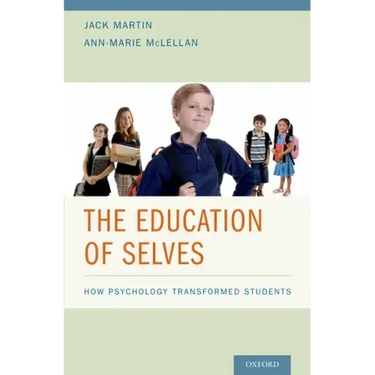

Education of Selves: How Psychology Transformed Students - Hardcover
 Education of Selves: How Psychology Transformed Students - Hardcover
$195.10
/
Education of Selves: How Psychology Transformed Students - Hardcover
$195.10
/

products.product.pickup_availability.unavailable

Your payment information is processed securely. We do not store credit card details nor have access to your credit card information.


by Jack Martin (Author), Ann-Marie McLellan (Author)
Most contemporary North Americans, as well as many other Westerners, take for granted their conceptions of themselves as individuals with uniquely valuable and complex inner lives -- lives filled with beliefs, imaginings, understandings, and motives that determine their actions and accomplishments. Yet, such psychological conceptions of selfhood are relatively recent, dating mostly from the late eighteenth century. Perhaps more surprisingly, our understandings of ourselves as creatively self-expressive and strategically self-managing are, for the most part, products of twentieth-century innovations in Enlightenment-based social sciences, especially psychology. Fueled by the enthusiasm for self-expression and self-actualization that emerged in the 1960s, humanistic, cognitive, developmental, and educational psychologists published widely on the overwhelmingly positive consequences of increased self-esteem in children and adolescents. While previous generations had been wary of
self-confidence and self-interest, these qualities became widely regarded as desirable traits to be cultivated in both the home and the school.
criticism may be interpreted, at least in part, as a reaction to the scientific and professional activities of psychologists, many of whom now appear to share in the general concern about where their activities have left students, schools, and society at large.
Author Biography
Jack Martin is Burnaby Mountain Endowed Professor in Historical, Quantitative, and Theoretical Psychology at Simon Fraser University. In addition to his interests in the theory, history, and methods of psychology, he conducts research in educational psychology, social-developmental psychology, cultural psychology, narrative psychology, and psychotherapy. He is especially interested in the psychology of personhood, including selfhood, moral and rational agency, perspective taking, personal and social identity, and the socio-cultural bases of personhood.

