
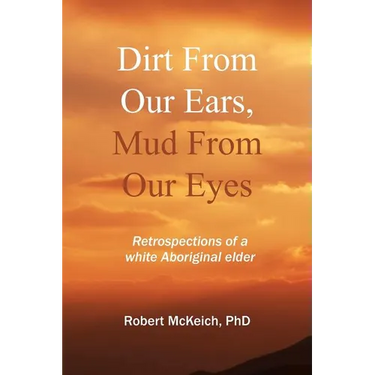

Dirt from our ears, Mud from our eyes: Retrospections of a white aboriginal elder - Paperback
 Dirt from our ears, Mud from our eyes: Retrospections of a white aboriginal elder - Paperback
$21.83
/
Dirt from our ears, Mud from our eyes: Retrospections of a white aboriginal elder - Paperback
$21.83
/

products.product.pickup_availability.unavailable

Your payment information is processed securely. We do not store credit card details nor have access to your credit card information.


by Robert McKeich (Author)
From a full, active life I chose several personal experiences to tell my new great grandson about me, his great grandfather whose name he carrys, Robert. My role as a milkman is a metaphor of life, my experiences with the desert Aborigines of Western Australia in the 1950s, reflections on marriage, travel, and thoughts gleaned from sociology, anthropology, and philosophy. i share with him and you, the reader, my joy of life, my bliss. - Robert Many white academics have studied the Australian Aborigines, but few have earned the respect of the Aboriginal people sufficiently to invite them to be initiated into a tribe. Robert McKeich is one of the few. His first encounter with the Australian Aborigines was as a school teacher and missionary, intent on converting indigenous Australians to the white man's way and to Christian religion. But somewhere along the way he found the depth and beauty of the Aboriginal way, a way of experiencing the world that westerners and 'civilised' societies, clouded by dirt in our ears and mud in our eyes, have long forgotten and generally do not understand. Robert learned much from the Aborigines about himself and life. Over many years of academic life and living to the full, he distilled his learnings and experiences into a simple and elegant wisdom that enabled him to live a fulfilled life and deeply loving relationships. He wrote this book in his last days as he moved towards the Dreamtime, so that we may all benefit from the remarkable journey of this great soul.
Author Biography
Robert McKeich, born in Auckland, New Zealand in1923. He grew up through the Great Depression years. Robert served three years in the New Zealand Army and Air Force in World War II. He has four children. In 1954 moved from the luscious green of New Zealand to the brown and red desert at Cundeelee in Western Australia to open a government school for Aborigines. That was a transforming experience. He came to teach but was taught so much as his mind was opened to the deeper aspects of their culture. 21 years after that first meeting, at 52, he was privileged to undergo a ritual that changed him from a "child" to a "man" in the Aboriginal tradition. The significance of that act was mighty, linking him with the social network, and beginning connections with Aboriginal transcendence. He recognised his ignorance of Aboriginal culture so studied at the University of Western Australia majoring in Psychology and Anthropology, and gained his PhD in Anthropology. He pioneered the Katukutu Hostel for Aboriginal young men in Perth against the opposition of neighbors and the indifference of the Native Welfare Department. Taught school and studied at the university at the same time. He met Gayle, his wife, in Shawnee Oklahoma on New Year's Eve 1971-72 and then began life with her in peace, fun, adventure and bliss. He kept a daily journal since 1978 without missing a day, and photographs of the Aborigines that are safely deposited in the Battye Library Archives in Perth, Australia. In 1995 had his first heart surgery, and a second surgery to implant a porcine mitral valve in 1997. A pacemaker, CPAP machine, oxygen line 24/7, many medications, and regular monitoring maintain a reasonable quality of life. With congestive heart failure, right pulmonary hypertension, and paralyzed left vocal chords his physical activities are somewhat restricted. He struggles through each day. Yet his sense of humour is still intact. He remembers. He can create. Those faculties still remain. At age 88 he published his first book. Finally being able to share the stories and poems he had written with the world. As he nears the end of his life's journey in this world he looks back with great pleasure and would like more time. More time to walk the beaches, stroll in the bush, sit down with family and friends, teach again, visit the places he loved, and relax into his bliss. However the Aborigines taught him that time is no time, but Everywhen.

