
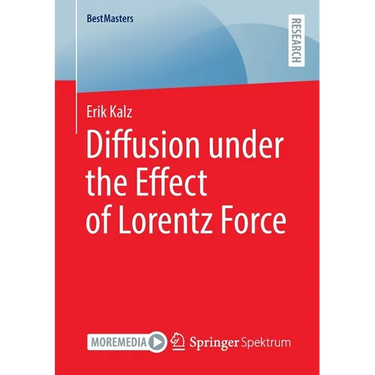

Diffusion Under the Effect of Lorentz Force - Paperback
 Diffusion Under the Effect of Lorentz Force - Paperback
$136.58
/
Diffusion Under the Effect of Lorentz Force - Paperback
$136.58
/

products.product.pickup_availability.unavailable

Your payment information is processed securely. We do not store credit card details nor have access to your credit card information.


by Erik Kalz (Author)
It is generally believed that collisions of particles reduce the self-diffusion coefficient. In this book, Erik Kalz shows that in classical systems under the effect of Lorentz force, which are characterized by diffusion tensors with antisymmetric elements, collisions surprisingly can enhance self-diffusion. In these systems, due to an inherent curving effect, the motion of particles is facilitated, instead of hindered by collisions. Consistent with this the author finds that the collective diffusion remains unaffected. Using a geometric model, he theoretically predicts a magnetic field governed crossover from a reduced to an enhanced self-diffusion. The physical interpretation is quantitatively supported by the force autocorrelation function, which turns negative with increasing the magnetic field. Using Brownian-dynamics simulations, he validates the predictions.
Back Jacket
It is generally believed that collisions of particles reduce the self-diffusion coefficient. In this book, Erik Kalz shows that in classical systems under the effect of Lorentz force, which are characterized by diffusion tensors with antisymmetric elements, collisions surprisingly can enhance self-diffusion. In these systems, due to an inherent curving effect, the motion of particles is facilitated, instead of hindered by collisions. Consistent with this the author finds that the collective diffusion remains unaffected. Using a geometric model, he theoretically predicts a magnetic field governed crossover from a reduced to an enhanced self-diffusion. The physical interpretation is quantitatively supported by the force autocorrelation function, which turns negative with increasing the magnetic field. Using Brownian-dynamics simulations, he validates the predictions.
About the AuthorErik Kalz holds a master's degree in physics from the Technical University of Dresden. He is interested in statistical physics with applications in soft condensed matter physics and biological physics. In 2022 he will start his PhD in theoretical physics at the University of Potsdam.
Author Biography
Erik Kalz holds a master's degree in physics from the Technical University of Dresden. He is interested in statistical physics with applications in soft condensed matter physics and biological physics. In 2022 he will start his PhD in theoretical physics at the University of Potsdam.

