
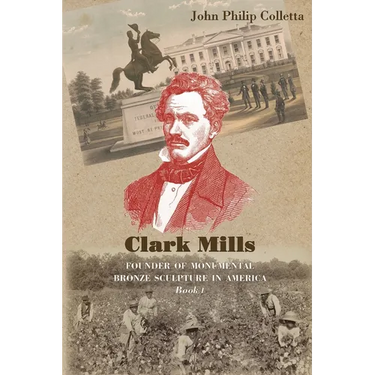

Clark Mills, Founder of Monumental Bronze Sculpture in America: A Story of the Slaveholding South in Washington, D.C. - Paperback
 Clark Mills, Founder of Monumental Bronze Sculpture in America: A Story of the Slaveholding South in Washington, D.C. - Paperback
$50.20
/
Clark Mills, Founder of Monumental Bronze Sculpture in America: A Story of the Slaveholding South in Washington, D.C. - Paperback
$50.20
/

products.product.pickup_availability.unavailable

Your payment information is processed securely. We do not store credit card details nor have access to your credit card information.


by John Philip Colletta (Author)
In Washington, D.C., stands a monumental statue of General Andrew Jackson in uniform astride a rearing steed. Unveiled in 1853, it was the first large statue of bronze ever cast in the United States. Moreover, it was the first equestrian statue of heroic size anywhere in the world that balanced solely on the horse's hind legs. Scientists had insisted that such a statue was impossible. Moreover, no foundry in the country was equipped to cast one. But Clark Mills did it. He was a runaway orphan from upstate New York, scarcely literate, but full of pluck and ambition. Meandering to South Carolina, he learned how to make portrait busts of plaster. By 1847, he had created a pantheon of the elite citizens of the Palmetto State, who sent their talented "fellow townsman" to the Nation's Capital to advance in his trade. There, however, a chance encounter inspired Mills to reach for a much more audacious goal. This book tells the story of how the patronage of wealthy slaveholders empowered a brilliant, penniless rebel to create the Jackson equestrian. It took him six years of self-training, solitary struggle, mishaps, ever-deepening debt, and the alienation of his wife and sons. The masses loved him. But the art establishment deemed him just a clever tradesman whose Jackson was clumsy and unsuitable, because Mills had dared to portray the "Hero of New Orleans," not in the neoclassical style considered appropriate, but rather in a naturalistic manner. In his iconoclasm, his determination to improve his lot, his work ethic, his shameless self-promotion and fierce entrepreneurial drive, Mills epitomized mid-19th-century America.

