
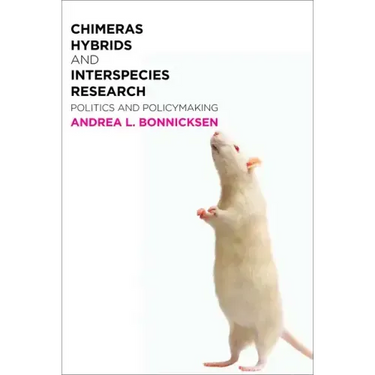

Chimeras, Hybrids, and Interspecies Research: Politics and Policymaking - Paperback
 Chimeras, Hybrids, and Interspecies Research: Politics and Policymaking - Paperback
$114.91
/
Chimeras, Hybrids, and Interspecies Research: Politics and Policymaking - Paperback
$114.91
/

products.product.pickup_availability.unavailable

Your payment information is processed securely. We do not store credit card details nor have access to your credit card information.


by Andrea L. Bonnicksen (Author), Andrea L. Bonnicksen (Contribution by)
In his 2006 State of the Union speech, President George W. Bush asked the U.S. Congress to prohibit the "most egregious abuses of medical research," such as the "creation of animal-human hybrids." The president's message echoed that of a 2004 report by the President's Council on Bioethics, which recommended that hybrid human-animal embryos be banned by Congress.
Discussions of early interspecies research, in which cells or DNA are interchanged between humans and nonhumans at early stages of development, can often devolve into sweeping statements, colorful imagery, and confusing policy. Although today's policy advisory groups are becoming more informed, debate is still limited by the interchangeable use of terms such as chimeras and hybrids, a tendency to treat all forms of interspecies alike, the failure to distinguish between laboratory research and procreation, and not enough serious policy justification. Andrea Bonnicksen seeks to understand reasons behind support of and disdain for interspecies research in such areas as chimerism, hybridization, interspecies nuclear transfer, cross-species embryo transfer, and transgenics. She highlights two claims critics make against early interspecies studies: that the research will violate human dignity and that it can lead to procreation. Are these claims sufficient to justify restrictive policy?
Bonnicksen carefully illustrates the challenges of making policy for sensitive and often sensationalized research--research that touches deep-seated values and that probes the boundary between human and nonhuman animals.
Front Jacket
In his 2006 State of the Union speech, President George W. Bush asked the U.S. Congress to prohibit the "most egregious abuses of medical research," such as the "creation of animalhuman hybrids." The president's message echoed that of a 2004 report by the President's Council on Bioethics, which recommended that hybrid humananimal embryos be banned by Congress.
Discussions of early interspecies research, in which cells or DNA are interchanged between humans and nonhumans at early stages of development, can often devolve into sweeping statements, colorful imagery, and confusing policy. Although today's policy advisory groups are becoming more informed, debate is still limited by the interchangeable use of terms such as chimeras and hybrids, a tendency to treat all forms of interspecies alike, the failure to distinguish between laboratory research and procreation, and not enough serious policy justification. Andrea Bonnicksen seeks to understand reasons behind support of and disdain for interspecies research in such areas as chimerism, hybridization, interspecies nuclear transfer, cross-species embryo transfer, and transgenics. She highlights two claims critics make against early interspecies studies: that the research will violate human dignity and that it can lead to procreation. Are these claims sufficient to justify restrictive policy?
Bonnicksen carefully illustrates the challenges of making policy for sensitive and often sensationalized researchresearch that touches deep-seated values and that probes the boundary between human and nonhuman animals.
Author Biography
Andrea L. Bonnicksen is Distinguished Research Professor and former chair of the Department of Political Science at Northern Illinois University. She is the author of Crafting a Cloning Policy: From Dolly to Stem Cells and In Vitro Fertilization: Building Policy from Laboratories to Legislatures.

