

BooksCloudSKU: 9781531513603
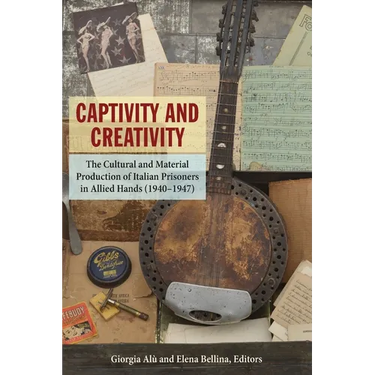
Captivity and Creativity: The Cultural and Material Production of Italian Prisoners in Allied Hands (1940-1947) - Paperback
$75.40
/
Shipping calculated at checkout.
In stock (50)
$75.40
 Captivity and Creativity: The Cultural and Material Production of Italian Prisoners in Allied Hands (1940-1947) - Paperback
$75.40
/
Captivity and Creativity: The Cultural and Material Production of Italian Prisoners in Allied Hands (1940-1947) - Paperback
$75.40
/

Captivity and Creativity: The Cultural and Material Production of Italian Prisoners in Allied Hands (1940-1947) - Paperback
$75.40
/
products.product.pickup_availability.unavailable
Still deciding?

Payment & Security
Your payment information is processed securely. We do not store credit card details nor have access to your credit card information.
Security
Related categories


High-Quality MaterialsMade with premium materials for long-lasting use.
Easy to UseSimple design for quick setup and convenience.
Versatile & Multi-PurposePerfect for home, office, or on-the-go.
Satisfaction GuaranteeLove it or return it for a full refund.
by Giorgia Alù (Editor), Elena Bellina (Editor), Giorgia Alù (Contribution by)
A groundbreaking volume that represents the first examination of cultural production amongst Italian prisoners of war
Captivity and Creativity explores the artistic and material production by Italian prisoners of war (POWs) and some civilian internees who were captured by the Western Allies in 1940-43 and detained in prison camps scattered across Africa, Australia, India, the United Kingdom, and the United States during World War II. Twelve chapters discuss from different theoretical and histori-cal angles the various artistic activities (e.g., theatre, music, visual arts, architecture, chapels, and material objects), technical contributions (e.g., maps, photography, radio), writings (e.g., memoirs, diaries, letters, and fiction), as well as the documentary evidence that resulted from the diverse experiences and transnational exchanges between the prisoners and their captors as military personnel and local civilian populations in different parts of the globe between 1940 and 1947. The book describes the prisoners' economic importance for the Western Allied powers in their war effort to fight Nazi-Fascism and the enforced diaspora through which POWs were moved across different allied countries. It analyzes the prisoners' daily camp life, work, and treatment before and after the 1943 Armistice, when POWs were asked to sign an agreement to renounce Fascism and become cooperators of war, underlining the different treatment reserved for coop-erators of war and noncooperators of war. The book also investigates the legacy of the prisoners' artistic and material production, the cultural heritage and the practices of memorialization (e.g., photography, monuments, museums, anniversary celebrations, exhibits) that have derived from the Italian presence in camps in different countries up to this date, through reference to groups and communities that preserve that heritage.Author Biography
Giorgia Alù (Edited By)
Giorgia Alù is Chair of Italian Studies at the University of Sydney. She is the author of Journeys Exposed: Women's Writing, Mobility, and Photography and co-editor of Enlightening Encounters: Italian Literature and Photography.
Elena Bellina is Visiting Assistant Clinical Professor in Italian Studies at New York University. Her research and publications focus on war and captivity studies, cultural memory, autobiographical writing, and the performing arts.
Number of Pages: 432
Dimensions: 0.89 x 9 x 6 IN
Publication Date: July 14, 2026
Free shipping on all U.S. orders
Easy returns and exchanges
30 day money back guarantee

%20-%20Paperback)