
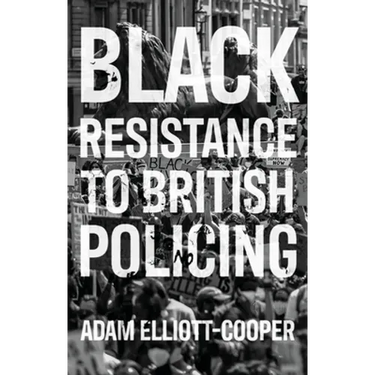

Black Resistance to British Policing - Hardcover
 Black Resistance to British Policing - Hardcover
$64.19
/
Black Resistance to British Policing - Hardcover
$64.19
/

products.product.pickup_availability.unavailable

Your payment information is processed securely. We do not store credit card details nor have access to your credit card information.


by Adam Elliott-Cooper (Author)
As police racism unsettles Britain's tolerant self-image, Black resistance to British policing details the activism that made movements like Black Lives Matter possible. Elliott-Cooper analyses racism beyond prejudice and the interpersonal - arguing that black resistance confronts a global system of racial classification, exploitation and violence.
Imperial cultures and policies, as well as colonial war and policing highlight connections between these histories and contemporary racisms. But this is a book about resistance, considering black liberation movements in the 20th century while utilising a decade of activist research covering spontaneous rebellion, campaigns and protest in the 21st century. Drawing connections between histories of resistance and different kinds of black struggle against policing is vital, it is argued, if we are to challenge the cutting edge of police and prison power which harnesses new and dangerous forms of surveillance, violence and criminalisation.Front Jacket
'Without a doubt, Elliott-Cooper is a critical voice anchoring urgent conversations about the dynamics of Black resistance in the UK. Powerfully argued and compelling.' Kennetta Hammond Perry, Director of the Stephen Lawrence Research Centre and author of London is the Place for Me 'A must-read for researchers, organisers or students. The book builds toward abolition understood as the capacity for self-determination, not only for people like those vividly portrayed in these pages, but for all who struggle to end oppression.' Ruth Wilson Gilmore, author of The Golden Gulag 'A comprehensive and timely examination of the function and practices of the police as a control apparatus of the state as they seek to regulate black people's presence in the society and its institutions.' Gus John, Associate Professor, UCL Institute of Education and author of Moss Side 1981 'Brother Adam Elliott-Cooper has given us an important slice of Black British history. Grounded not just in solid academic research, but also in front line work serving and working with communities. Adam's grasp of both history and the reality on the ground today makes for an impressive read as he brings to life the characters and communities resisting policing.' Akala Britain has long viewed itself as tolerant and open, but institutional police racism continues to unsettle and challenge this interpretation. Black resistance to British policing offers the first detailed account of grassroots anti-racist resistance. From twentieth-century liberation movements, to the 2011 'riots' and into present day Black Lives Matter protests, Elliott-Cooper traces how colonial legacies and modern state power are used to classify, control, exploit and perpetrate violence. Using a decade of research into activism, spontaneous rebellion and campaigning, Elliott-Cooper uncovers how British racism stretches back much further than the Windrush scandal, and beyond the shores of the mainland, to its imperial cultures and policies across the Empire. The police and prison systems are beyond reform, Elliott-Cooper argues, and to imagine a world free from racism we must work towards a system free from the violence and exploitation that makes racism possible.
Back Jacket
'Without a doubt, Elliott-Cooper is a critical voice anchoring urgent conversations about the dynamics of Black resistance in the UK. Powerfully argued and compelling.'
Kennetta Hammond Perry, Director of the Stephen Lawrence Research Centre and author of London is the Place for Me
Ruth Wilson Gilmore, author of Golden Gulag 'A comprehensive and timely examination of the function and practices of the police as a control apparatus of the state as they seek to regulate black people's presence in the society and its institutions.'
Gus John, Associate Professor, UCL Institute of Education and author of Moss Side 1981 'Brother Adam Elliott-Cooper has given us an important slice of Black British history. Grounded not just in solid academic research, but also in front line work serving and working with communities. Adam's grasp of both history and the reality on the ground today makes for an impressive read as he brings to life the characters and communities resisting policing.'
Akala Britain has long viewed itself as tolerant and open, but institutional police racism continues to unsettle and challenge this interpretation. Black resistance to British policing offers the first detailed account of grassroots anti-racist resistance. From twentieth-century liberation movements, to the 2011 'riots' and into present day Black Lives Matter protests, Elliott-Cooper traces how colonial legacies and modern state power are used to classify, control, exploit and perpetrate violence. Using a decade of research into activism, spontaneous rebellion and campaigning, Elliott-Cooper uncovers how British racism stretches back much further than the Windrush scandal, and beyond the shores of the mainland, to its imperial cultures and policies across the Empire. The police and prison systems are beyond reform, Elliott-Cooper argues, and to imagine a world free from racism we must work towards a system free from the violence and exploitation that makes racism possible.
Author Biography
Adam Elliott-Cooper is a research associate in sociology at the University of Greenwich

