
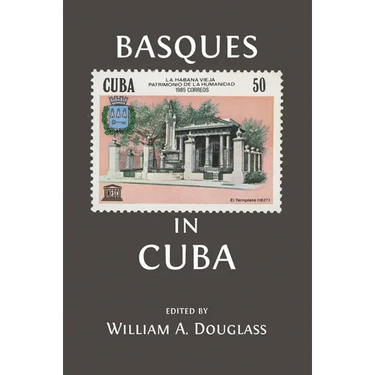

Basques in Cuba - Paperback
 Basques in Cuba - Paperback
$47.50
/
Basques in Cuba - Paperback
$47.50
/

products.product.pickup_availability.unavailable

Your payment information is processed securely. We do not store credit card details nor have access to your credit card information.


by William A. Douglass (Editor), Aritz Branton (Translator)
Taking as their inspiration and cue Jon Bilbao's book Vascos en Cuba, 1492-1511, the authors of this book, a collection of international academics, take up the subject of the involvement of the Basque people in Cuba from a variety of viewpoints and analytical and theoretical perspectives. The Basque Country has had a long and varied relationship with Cuba, its people, and its history. The chapters in this volume trace that connection based on diverse topics and viewpoints: the representations of Basques in classic Cuban poetry and Cuba as a topic in the nineteenth-century Basque novel; the involvement of Basques in the African slave trade, the role of the Tree in Gernika in Cuba's Templete monument, the service of Basque parliamentarians and soldiers in Spain's former colony, and the politics of Basque priests on the island are all treated, as well as much more. There are also chapters that consider the involvement of Basques regionally, in places such as Cienfuegos, Santiago de Cuba, Vueltabajo, and Havana. Edited by renowned Basque scholar William A. Douglass, this volume provides an important contribution in reclaiming a mostly neglected history.
Author Biography
William A. Douglass was born in Reno, Nevada, in 1939. He received
his BA from the University of Nevada in Spanish Literature in 1961, then
earned his MS in 1966, and then PhD from the University of Chicago in
Anthropology in 1967. He also attended the University of Madrid from
1959-60, the University of Oslo in 1960, and UC Berkeley from 1962-3. In
1967, he joined the Anthropology faculty at UNR and founded the Basque
Studies Program, now known as the Center for Basque Studies. He was its
first director and served in that capacity for 33 years.
Considered one of the foremost experts in Basque Studies, Douglass
also has language competency in Spanish, French, Italian, and Latin. He
is a member of the American Anthropological Association, Current
Anthropology, and Instituto Americano de Estudios Vascos. He obtained
National Institute of Mental Health research scientist career
development grants in 1971 and 1976, each of them 5-year grants. In
2002, the Society for the Anthropology of Europe established the William
A. Douglass Prize in Europeanist Anthropology, an annual book award.

