
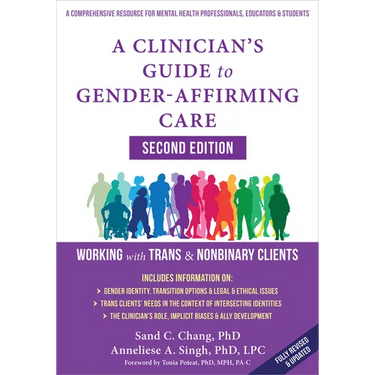

A Clinician's Guide to Gender-Affirming Care: Working with Trans and Nonbinary Clients - Paperback
 A Clinician's Guide to Gender-Affirming Care: Working with Trans and Nonbinary Clients - Paperback
$66.95
/
A Clinician's Guide to Gender-Affirming Care: Working with Trans and Nonbinary Clients - Paperback
$66.95
/

products.product.pickup_availability.unavailable

Your payment information is processed securely. We do not store credit card details nor have access to your credit card information.


by Anneliese A. Singh (Author), Sand C. Chang (Author), Tonia Poteat (Foreword by)
An essential and comprehensive resource for treating trans and nonbinary (TNB) clients--now fully revised and updated.
Trans and nonbinary (TNB) clients have complex mental health concerns, and are more likely than ever to seek out treatment. At the same time, best practices for treating this population have evolved at a rapid pace. This professional guide presents the latest research and recommendations to provide you with the requisite knowledge, skills, and awareness needed to improve treatment outcomes for TNB clients.
Written by two leading TNB specialists, this fully revised and updated edition of A Clinician's Guide to Gender-Affirming Care offers interventions that are uniquely tailored to TNB clients, and that consider cultural intersections such as race, class, and religion. You'll find up-to-date information on language, etiquette, and appropriate communication when treating TNB clients, as well as an outline of the history, cultural context, and ethical and legal issues that can arise in working with gender diverse individuals in a clinical setting.
You'll also find information about informed consent when providing assessment and referral for the purposes of gender-affirming medical care, such as hormones, surgery, and other procedures.
This second edition also features new information on the current state of gender-affirming care, providing care across a client's lifespan, conceptualization and collaboration in transition-related care, supporting gender-expansive youth and their parents, advances in research, and more.
You'll also find information on:
- Evolving legislation on the provision of TNB care
- Political impacts at the national level
- Intersectionality and its relevance in treatment
- Research on TNB identity development
- Actionable skills to help clients feel more empowered
Given the changes in transgender health care, insurance coverage, and the legislative and sociopolitical landscape, it is essential to understand trans and nonbinary clients' different needs. This book provides the vital insights, practical exercises, and skills you need to help your TNB clients thrive.
Author Biography
Sand C. Chang, PhD (they/them), is a Chinese American nonbinary psychologist and trainer. They have a private practice specializing in eating disorders, trauma healing, and trans health. They are cofounder of Queer and Trans Internal Family Systems (QTIFS), and a trainer with the IFS Institute, as well as author of All Parts Welcome: The Queer and Trans Internal Family Systems Workbook. Outside of their professional work, Sand is a dancer, avid foodie, and pug enthusiast.
Anneliese A. Singh, PhD, LPC(she/they), is a professor at Tulane University. Anneliese is author ofThe Racial Healing Handbook and The Queer and Transgender Resilience Workbook. Trained as a counseling psychologist and counselor educator, Singh's research explores trans and nonbinary identity development, resilience, and liberation, as well as racial trauma and racial healing. Anneliese cofounded the Trans Resilience Project and Georgia Safe Schools Coalition to help build safer school and community environments for LGBTQ+ communities. Anneliese is a Sikh, South Asian, mixed race, genderqueer femme who was born and raised in New Orleans.
Foreword writer Tonia Poteat, PhD, MPH, PA-C, is a professor at the Duke University School of Nursing, and codirector of the Duke SGM Wellness Program. Her research, teaching, and clinical practice focus on HIV and LGBTQ+ health, with particular attention to the health of transgender communities. Her research attends to the role of intersectional structural stigma in driving health inequities, and seeks to identify strategies to advance health justice.

