
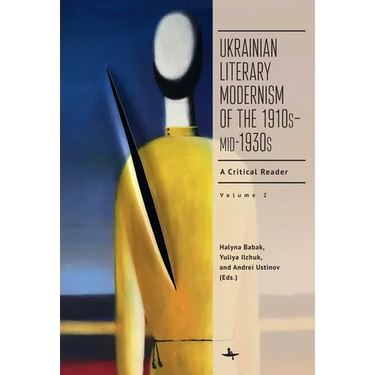

Ukrainian Literary Modernism of the 1910s-Mid-1930s, Vol II: A Critical Reader - Hardcover
 Ukrainian Literary Modernism of the 1910s-Mid-1930s, Vol II: A Critical Reader - Hardcover
$158.15
/
Ukrainian Literary Modernism of the 1910s-Mid-1930s, Vol II: A Critical Reader - Hardcover
$158.15
/

products.product.pickup_availability.unavailable

Your payment information is processed securely. We do not store credit card details nor have access to your credit card information.


by Halyna Babak (Editor), Yuliya Ilchuk (Editor), Andrei Ustinov (Editor)
The Reader introduces Anglophone audiences to the original theoretical writings and poetry produced in Ukraine from the 1910s through the emergence of the totalitarian state under Stalin in the mid-1930s. It captures the vibrancy of a cultural moment when modernism and the avant-garde became the leading forms of artistic, literary, and intellectual expression. Far from being a peripheral phenomenon, Ukrainian modernism evolved in a dynamic dialogue with both European and Russian counterparts while maintaining its own national and ideological distinctiveness. The Reader demonstrates how Formalist theory and avant-garde literary practice shaped poetic creation and, in turn, how these aesthetic innovations engaged with broader projects of Soviet modernization and nation-building. By bringing together key critical and poetic works that reveal the tension between national aspirations and avant-garde currents in Ukrainian culture, the book redefines Ukrainian modernism as a movement uniting theoretical innovation, artistic experimentation, and political engagement. It invites readers to recognize how, forged in the crucible of the early Soviet decades, literature emerged not only as a reflection but also as a maker of modernity.
Author Biography
Halyna Babak is a Ukrainian scholar whose research explores the intellectual history, literary theory, and literary production of 20th-century Ukraine within the broader context of Soviet and East European political and cultural history. Her first monograph The Atlantis of Soviet National Modernism [Natsmodernism]: The Formal Method in Ukraine (1920s-Early 1930s) (2021, co-authored with A. Dmitriev), offers the first comprehensive interpretation of the role of Ukrainian Formalism in nation-building during the 1920s as part of the broader project of Soviet modernization.
Yuliya Ilchuk is a Ukrainian scholar and translator whose research focuses on cultural exchange, interaction, and "borrowing" between Russia and Ukraine. Her award-winning book, Nikolai Gogol: Performing Hybrid Identity (2021), reinterprets the writer's identity and his literary works as ambivalent and hybrid. Her recent projects engage with memory studies in post-1991 Ukraine, shifting scholarly attention from collective remembrance to the cultural dimensions of forgetting. Also, she actively translates both modernist and contemporary Ukrainian poetry in tandem with Amelia Glaser.
Andrei Ustinov received his PhD from Stanford University and is currently a Fellow at the Center for Open Studies. His scholarship examines European cultural history, highlighting the interplay between literary theory and artistic practice in modernist and avant-garde movements. He has authored and edited several books, including the comprehensive study Russian Literary Avant-Garde in Paris (with Leonid Livak), and has published widely on poetic experimentation. His current work centers on the rediscovery of texts and contexts of Ukrainian modernism.

