
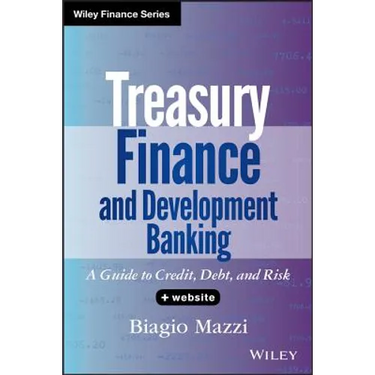

Treasury Finance and Development Banking, + Website: A Guide to Credit, Debt, and Risk - Hardcover
 Treasury Finance and Development Banking, + Website: A Guide to Credit, Debt, and Risk - Hardcover
$101.00
/
Treasury Finance and Development Banking, + Website: A Guide to Credit, Debt, and Risk - Hardcover
$101.00
/

products.product.pickup_availability.unavailable

Your payment information is processed securely. We do not store credit card details nor have access to your credit card information.


by Biagio Mazzi (Author)
Credit and credit risk permeates every corner of the financial world. Previously credit tended to be acknowledged only when dealing with counterparty credit risk, high-yield debt or credit-linked derivatives, now it affects all things, including such fundamental concepts as assessing the present value of a future cash flow. The purpose of this book is to analyze credit from the beginning--the point at which any borrowing entity (sovereign, corporate, etc.) decides to raise capital through its treasury operation. To describe the debt management activity, the book presents examples from the development banking world which not only presents a clearer banking structure but in addition sits at the intersection of many topical issues (multi-lateral agencies, quasi-governmental entities, Emerging Markets, shrinking pool of AAA borrowers, etc.).
This book covers:
- Curve construction (instruments, collateralization, discounting, bootstrapping)
- Credit and fair valuing of loans (modeling, development institutions)
- Emerging markets and liquidity (liquidity, credit, capital control, development)
- Bond pricing (credit, illiquid bonds, recovery pricing)
- Treasury (funding as an asset swap structure, benchmarks for borrowing/investing)
- Risk and asset liability management (leverage, hedging, funding risk)
Front Jacket
It used to be that credit and the cost of debt were considered only when dealing with counterparty credit risk, high-yield debt, or credit-linked derivatives. In the wake of the 2007-2009 credit crisis, that is no longer the case. Credit and credit risk are now of crucial concern throughout the banking sector and the financial markets.
But, as expert Biagio Mazzi explains, any practical knowledge of credit and debt must be rooted in a thorough understanding of where credit originates: i.e., in treasuries--or more specifically, the point at which a borrowing entity, such as a corporation, bank, or sovereign nation, decides to raise capital through its treasury or debt management operation.
Which is why it is so surprising that, until now, there were no books devoted to the impact of the treasury desk on the pricing and valuation of financial instruments. This book fills that gap in the literature, offering a formal, yet highly accessible overview of the structure and function of treasuries, along with in-depth discussions of how debt affects all subsequent downstream financial activities.
With the help of numerous real-world examples--including an abundance of graphs and market data screen shots--taken from the trading and development banking world, Dr. Mazzi explores an array of critical topics, including:
- Curve construction and the increasing role of credit in discounting
- Asset swaps as the key to funding
- Basic credit modeling as a framework for understanding default
- Fair value of loans and its implications
- Emerging markets and their key financial characteristics
- Bond pricing and the challenges of illiquid or distressed debt
- Asset liability management as a manifestation of debt and credit flowing through an institution
On the Treasury Finance and Development Banking companion website, you'll find a host of powerful tools for implementing the practices covered in the book, including spreadsheets and macros, interest rate and credit modeling apps, and more.
The first practical guide to understanding how treasury funding affects the operations of financial institutions and, more importantly, how it impacts the ways in which activities are assessed, transactions priced, and financial risks managed, Treasury Management and Development Banking is an invaluable working resource for banking and other finance professionals, especially those involved in the fixed income markets.
Back Jacket
It used to be that credit and the cost of debt were considered only when dealing with counterparty credit risk, high-yield debt, or credit-linked derivatives. In the wake of the 2007-2009 credit crisis, that is no longer the case. Credit and credit risk are now of crucial concern throughout the banking sector and the financial markets.
But, as expert Biagio Mazzi explains, any practical knowledge of credit and debt must be rooted in a thorough understanding of where credit originates: i.e., in treasuries--or more specifically, the point at which a borrowing entity, such as a corporation, bank, or sovereign nation, decides to raise capital through its treasury or debt management operation.
Which is why it is so surprising that, until now, there were no books devoted to the impact of the treasury desk on the pricing and valuation of financial instruments. This book fills that gap in the literature, offering a formal, yet highly accessible overview of the structure and function of treasuries, along with in-depth discussions of how debt affects all subsequent downstream financial activities.
With the help of numerous real-world examples--including an abundance of graphs and market data screen shots--taken from the trading and development banking world, Dr. Mazzi explores an array of critical topics, including:
- Curve construction and the increasing role of credit in discounting
- Asset swaps as the key to funding
- Basic credit modeling as a framework for understanding default
- Fair value of loans and its implications
- Emerging markets and their key financial characteristics
- Bond pricing and the challenges of illiquid or distressed debt
- Asset liability management as a manifestation of debt and credit flowing through an institution
On the Treasury Finance and Development Banking companion website, you'll find a host of powerful tools for implementing the practices covered in the book, including spreadsheets and macros, interest rate and credit modeling apps, and more.
The first practical guide to understanding how treasury funding affects the operations of financial institutions and, more importantly, how it impacts the ways in which activities are assessed, transactions priced, and financial risks managed, Treasury Management and Development Banking is an invaluable working resource for banking and other finance professionals, especially those involved in the fixed income markets.
Author Biography
BIAGIO MAZZI, PHD, is a Senior Financial Officer on the Structured Notes Desk in the World Bank Treasury. Prior to the World Bank, Biago Mazzi was a Vice President at Morgan Stanley, where he was responsible for modeling exotic credit derivatives on the Emerging Markets Desk. Before working in fixed income, he was an equity derivatives quant at Barclays Capital and Banca Caboto. He holds a PhD in theoretical physics from the University of Cambridge.

