
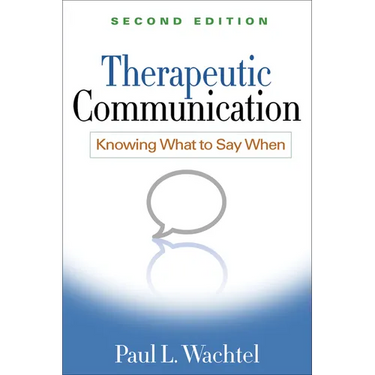

Therapeutic Communication: Knowing What to Say When - Paperback
 Therapeutic Communication: Knowing What to Say When - Paperback
$83.14
/
Therapeutic Communication: Knowing What to Say When - Paperback
$83.14
/

products.product.pickup_availability.unavailable

Your payment information is processed securely. We do not store credit card details nor have access to your credit card information.


by Paul L. Wachtel (Author)
A uniquely practical guide and widely adopted text, this book shows precisely what therapists can say at key moments to enhance the process of healing and change. Paul Wachtel explains why some communications in therapy are particularly effective, while others that address essentially the same content may actually be countertherapeutic. He offers clear and specific guidelines for how to ask questions and make comments in ways that facilitate collaborative exploration and promote change. Illustrated with vivid case examples, the book is grounded in an integrative theory that draws from features of psychodynamic, cognitive-behavioral, systemic, and experiential approaches.
New to This Edition* Reflects nearly 20 years of advances in the field and refinements of the author's approach.
*Broader audience: in addition to psychodynamic therapists, cognitive-behavioral therapists and others will find specific, user-friendly recommendations.
*Chapter on key developments and convergences across different psychotherapeutic approaches.
*Chapter on the therapeutic implications of attachment theory and research. See also Making Room for the Disavowed, which further develops Wachtel's integrative therapeutic approach, as well as Mastering the Clinical Conversation, by Matthieu Villatte, Jennifer L. Villatte, and Steven C. Hayes, which provides another vital perspective on language in psychotherapy.
Author Biography
Paul L. Wachtel, PhD, is Distinguished Professor in the Clinical Psychology Doctoral Program at The City College of New York. Dr. Wachtel has been a leading voice for integrative thinking in the human sciences and is a cofounder and past president of the Society for the Exploration of Psychotherapy Integration. He is a recipient of the Hans H. Strupp Memorial Award; the Distinguished Psychologist Award from Division 29 (Psychotherapy) of the American Psychological Association (APA); the Scholarship and Research Award from Division 39 (Psychoanalysis) of APA; and the Sidney J. Blatt Award for Outstanding Contributions to Psychotherapy, Scholarship, Education and Practice.

