

BooksCloudSKU: 9781606180389
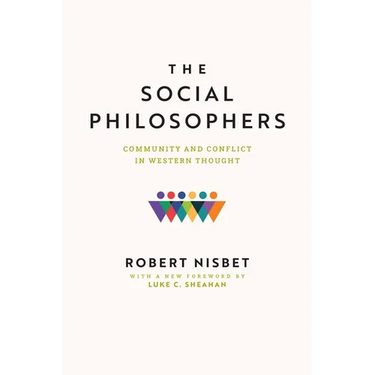
The Social Philosophers: Community and Conflict in Western Thought - Paperback
$40.97
/
Shipping calculated at checkout.
In stock (50)
$40.97
 The Social Philosophers: Community and Conflict in Western Thought - Paperback
$40.97
/
The Social Philosophers: Community and Conflict in Western Thought - Paperback
$40.97
/

The Social Philosophers: Community and Conflict in Western Thought - Paperback
$40.97
/
products.product.pickup_availability.unavailable
Still deciding?

Payment & Security
Your payment information is processed securely. We do not store credit card details nor have access to your credit card information.
Security
Related categories


High-Quality MaterialsMade with premium materials for long-lasting use.
Easy to UseSimple design for quick setup and convenience.
Versatile & Multi-PurposePerfect for home, office, or on-the-go.
Satisfaction GuaranteeLove it or return it for a full refund.
by Robert Nisbet (Author), Luke C. Sheahan (Foreword by)
Western ideas of moral authority, freedom, consensus, and personality emerge from humankind's search for community
In this provocative, classic, absorbing work of social and intellectual history, Robert Nisbet advances the idea that Western social philosophy arose during the disintegration of the ancient Greek and Roman communities, and has been preoccupied ever since with the problem of community lost and community to be gained. He further contends that Western ideas of moral authority, freedom, consensus, and personality take on their distinctive character when viewed through the lens of humankind's search for community. Much of the book's originality lies in its organization. Nisbet distinguishes six major types of community in Western life and thought: military, political, religious, revolutionary, ecological, and plural. Each of these is presented as a continuing current in Western history and as a vital context to the central ideas of social philosophy. From Plato and Aristotle down to such modern thinkers as Marx, Tocqueville, Weber, Kropotkin, and Fanon, we are able to see the dominant ideas and perspectives of Western thought as responses to conflicts and crises--above all, to those affecting humankind's quest for community. Written by one of America's best-known historical sociologists, and with a new foreword by Luke Sheahan, The Social Philosophers will be of interest to the student as well as the general reader.Author Biography
Robert Nisbet (1913-1996), a former Guggenheim fellow and member of the American Philosophical Society, was the author
of many books, among them The Quest for Community: A Study in the Ethics of Order and Freedom; Social Change and History; The Present Age: Progress and Anarchy in Modern America; and The Making of Modern Society.
Number of Pages: 440
Dimensions: 0.98 x 9.21 x 6.14 IN
Publication Date: September 02, 2025
Free shipping on all U.S. orders
Easy returns and exchanges
30 day money back guarantee

