
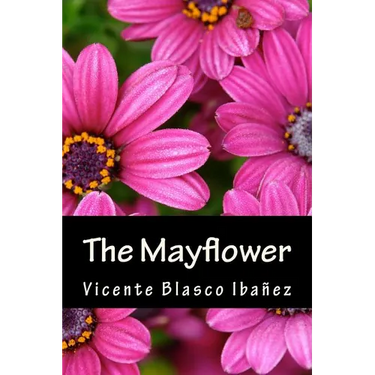

The Mayflower - Paperback
 The Mayflower - Paperback
$20.37
/
The Mayflower - Paperback
$20.37
/

products.product.pickup_availability.unavailable

Your payment information is processed securely. We do not store credit card details nor have access to your credit card information.


by Arthur Livingstone (Translator), Only Books (Editor), Vicente Blasco Ibanez (Author)
In 1895, "Flor de Mayo" was published, the second novel by the Valencian writer Vicente Blasco Ibáñez, originally written as a leaflet for the republican newspaper El Pueblo, founded by Blasco himself.Considered as one of the best novels written on men of the sea, is part of the cycle of Valencian costumbristas novels made by Blasco between 1894 and 1902, along with "Arroz y tartana", "Cañas y barro" and "La barraca".In "Flor de Mayo", Blasco takes us to his hometown, El Cabanyal, a small fisherman's neighborhood that supplies fish to the whole city of Valencia, at many times the life of some fishermen; A life he knew personally, as he recognized in the prologue he wrote for his reissue in 1923.
Author Biography
Vicente Blasco Ibáñez ( 1867 - 1928) was a journalist, politician and best-selling Spanish novelist in various genres whose most widespread and lasting fame in the English-speaking world is from Hollywood films adapted from his works. His first published novel was "La araña negra" ('The Black Spider') in 1892, an immature work that he later repudiated - a study of the connections between a noble Spanish family and the Jesuits throughout the 19th century. It seems to have been a vehicle for him to express his anti-clerical views. In 1894, he published his first mature work, a novel called "Arroz y tartana" (Airs and Graces). The story is about a widow in late 19th century Valencia trying to keep up appearances in order to marry her daughters well. His next books consist of detailed studies of aspects of rural life in the farmlands of Valencia - the so-called huerta that the Moorish colonizers had created to grow crops such as rice, vegetables and oranges, with a carefully planned irrigation system in an He was born in Valencia. At university, he studied law and graduated in 1888 but never went into practice. He was more interested in politics, journalism, literature and women. In politics he was a militant Republican partisan in his youth and founded a newspaper, El Pueblo (translated as either The Town or The People) in his hometown. The newspaper aroused so much controversy that it was taken to court many times. In 1896, he was arrested and sentenced to a few months in prison. He made many enemies and was shot and almost killed in one dispute. The bullet was caught in the clasp of his belt. He had several stormy love affairs. He volunteered as the proofreader for the novel Noli Me Tangere, in which the Filipino patriot José Rizal expressed his contempt of the Spanish colonization of the Philippines. He travelled to Argentina in 1909 where two new cities, Nueva Valencia and Cervantes, were created. He gave conferences on historical events and Spanish literature. Tired and disgusted with government failures and inaction, Vicente Blasco Ibáñez moved to Paris at the beginning of World War I. When living in Paris, Ibáñez had been introduced to the poet and writer Robert W. Service by their mutual publisher Fisher Unwin, who asked Robert W. Service to act as an interpreter in the deal of a contract concerning Ibáñez. He was a supporter of the Allies in World War I. He died in Menton, France in 1928, the day before his 61st birthday.

