
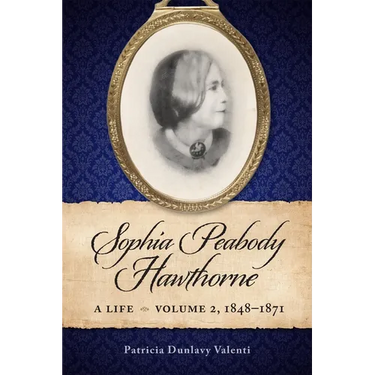

Sophia Peabody Hawthorne: A Life, Volume 2, 1848-1871 - Paperback
 Sophia Peabody Hawthorne: A Life, Volume 2, 1848-1871 - Paperback
$44.75
/
Sophia Peabody Hawthorne: A Life, Volume 2, 1848-1871 - Paperback
$44.75
/

products.product.pickup_availability.unavailable

Your payment information is processed securely. We do not store credit card details nor have access to your credit card information.


by Patricia Dunlavy Valenti (Author)
Despite an ignominious departure from Concord in 1846, Sophia continued--in Ralph Waldo Emerson's words--to see all things with a "beauty-making eye." She touted Nathaniel's perfections even when his failure to make a living forced a series of relocations, first to Salem, next to Lenox, and on to West Newton. Loans, gifts, and interventions from Sophia's friends helped pay her family's bills, as did Sophia's resourcefulness. She directed her creative talents to the production of decorative arts whose sale provided income while Nathaniel wrote The Scarlet Letter.
Sophia's character traits inform many elements in the three novels Nathaniel published during this time, his most prolific period, wherein he also earned the income needed to buy The Wayside in Concord from Bronson Alcott. Shortly after they moved in, Nathaniel's lifelong friend Franklin Pierce, now president of the United States, appointed him to a potentially lucrative sinecure as the United States Consul in Liverpool. Sophia embraced this opportunity to travel. Her letters and journals capture her enthusiasm for touring, often lacing her verbal descriptions with intricate sketches. Her sojourn without Nathaniel to the Portugal home of the United States Chargé d'Affaires John Louis O'Sullivan is documented in journals and letters that entertain the reader with amusing anecdotes about that country's culture and royal court. But it was travel in Italy that fulfilled her lifelong desires to view great art, which she appreciated in defiance of current American aesthetic norms. Her companions in Rome--the astronomer Maria Mitchell, the sculptor Harriet Hosmer, the actress Charlotte Cushman--were women whose "female marriages" challenged assumptions about normative heterosexual unions. Returning to Concord in 1860, and to the Civil War, Sophia found that her increasingly remote husband, fractious children, and staid Peabody sisters did not satisfy her appetite for intense relationships. Her long-standing friendship with Sarah Shaw, mother of Robert Gould Shaw, illuminates the sacrifices others made to free the slaves, while Sophia left their fate to providence. Sophia's intense attraction to Annie Fields, the wife of Nathaniel's publisher, expands or upends (depending on one's point of view) the notion of the Hawthornes' storied marital bliss. During Nathaniel's last years, he was shattered physically and mentally. The results of his feckless, improvident spending left her an impoverished widow. In defiance of his prohibitions, Sophia published some of her travel writing and edited and published his private writing, thereby turning writing into a commodity to support herself and her children. The years she had spent abroad widened her appreciation of art, religion, and international cultures, but loosened her ties to New England. In 1868, abandoning the Union that had so recently been saved, she became an expatriate. She died in England in 1871.Author Biography
Patricia Dunlavy Valenti is professor emerita of English at the University of North Carolina at Pembroke. An award-winning teacher who held visiting professorships at the U.S. Military Academy and the U.S. Air Force Academy, she is the author of five books and numerous articles on American literature and biography.

