
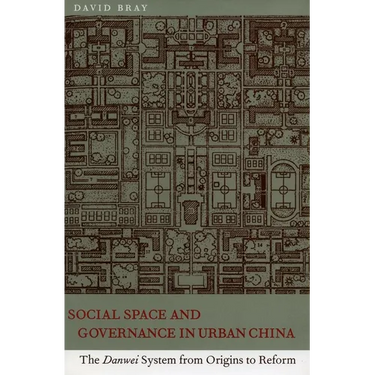

Social Space and Governance in Urban China: The Danwei System from Origins to Reform - Hardcover
 Social Space and Governance in Urban China: The Danwei System from Origins to Reform - Hardcover
$143.80
/
Social Space and Governance in Urban China: The Danwei System from Origins to Reform - Hardcover
$143.80
/

products.product.pickup_availability.unavailable

Your payment information is processed securely. We do not store credit card details nor have access to your credit card information.


by David Bray (Author)
The danwei (workunit) has been the fundamental social and spatial unit of urban China under socialism. With particular focus on the link between spatial forms and social organization, this book traces the origins and development of this critical institution up to the present day.
Front Jacket
Centered on the urban workplace, the danwei (workunit) has been the fundamental social and spatial unit of urban China under socialism. Not only was it the source of employment, wages, and other material benefits for the vast majority of urban residents, it was also the institution through which the urban population was housed, organized, regulated, policed, educated, trained, protected, and surveyed. Furthermore, as the basic unit of urban society, each danwei became a community, providing its members with identity, a "face," and social belonging.
With particular focus on the link between spatial forms and social organization, this book traces the origins and development of this critical institution up to the present day. Recent economic restructuring has seen the danwei lose its dominant role, yet its presence still influences the possibilities for urban transformation. Moreover, the author argues, the new institutions emerging in its place display important characteristics of the old danwei system.
Back Jacket
Centered on the urban workplace, the danwei (workunit) has been the fundamental social and spatial unit of urban China under socialism. Not only was it the source of employment, wages, and other material benefits for the vast majority of urban residents, it was also the institution through which the urban population was housed, organized, regulated, policed, educated, trained, protected, and surveyed. Furthermore, as the basic unit of urban society, each danwei became a community, providing its members with identity, a "face," and social belonging.
With particular focus on the link between spatial forms and social organization, this book traces the origins and development of this critical institution up to the present day. Recent economic restructuring has seen the danwei lose its dominant role, yet its presence still influences the possibilities for urban transformation. Moreover, the author argues, the new institutions emerging in its place display important characteristics of the old danwei system.
Author Biography
David Bray is Lecturer in Chinese Politics at the East Asian Institute, Faculty of Oriental Studies, Cambridge University.

