
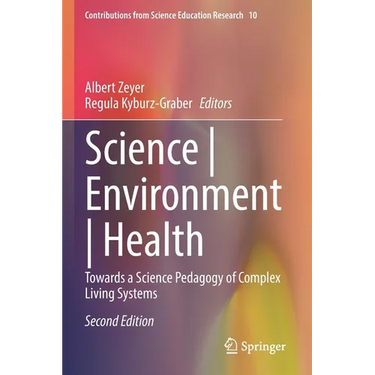

Science Environment Health: Towards a Science Pedagogy of Complex Living Systems - Paperback
 Science Environment Health: Towards a Science Pedagogy of Complex Living Systems - Paperback
$185.18
/
Science Environment Health: Towards a Science Pedagogy of Complex Living Systems - Paperback
$185.18
/

products.product.pickup_availability.unavailable

Your payment information is processed securely. We do not store credit card details nor have access to your credit card information.


by Albert Zeyer (Editor), Regula Kyburz-Graber (Editor)
This book provides a fascinating insight into the on-going process of self- reflection in the ScienceEnvironmentHealth (SEH) community. The basic vision of a new SEH pedagogy is to establish a transdisciplinary dialogue between the three educational fields of science education, environmental education, and health education. This approach finds growing interest among science educators. Since 2014, the ESERA special interest group SEH has united both experienced and junior researchers all over Europe in a burgeoning research community.
This book presents a selection of results of these vibrant activities. Systems theory has turned out to be a stimulating theoretical framework for SEH. The limits of predictability in complex living systems result in structural uncertainty for decision-making, and they ask for emphasising and rethinking the role of pedagogical concepts like informed citizenship and scientific literacy. They challenge crude scientific determinism inenvironmental and health education, which all too often ends up with students' eco- and health depression. Instead, SEH conceives coping with uncertainty in terms of an interplay between cognitive and affective factors. The horizon of the future remains always open. Hope must never die in a new SEH pedagogy.
Back Jacket
This book provides a fascinating insight into the on-going process of self- reflection in the ScienceEnvironmentHealth (SEH) community. The basic vision of a new SEH pedagogy is to establish a transdisciplinary dialogue between the three educational fields of science education, environmental education, and health education. This approach finds growing interest among science educators. Since 2014, the ESERA special interest group SEH has united both experienced and junior researchers all over Europe in a burgeoning research community.
This book presents a selection of results of these vibrant activities. Systems theory has turned out to be a stimulating theoretical framework for SEH. The limits of predictability in complex living systems result in structural uncertainty for decision-making, and they ask for emphasising and rethinking the role of pedagogical concepts like informed citizenship and scientific literacy. They challenge crude scientific determinism inenvironmental and health education, which all too often ends up with students' eco- and health depression. Instead, SEH conceives coping with uncertainty in terms of an interplay between cognitive and affective factors. The horizon of the future remains always open. Hope must never die in a new SEH pedagogy.
Chapter 3 is available open access under a Creative Commons Attribution 4.0 International License via link.springer.com.
Author Biography
Albert Zeyer, Dr. med. et dipl. math., is a mathematical physicist and physician. After working as a science teacher and a children's doctor in Swiss schools and hospitals, he was a senior researcher at the Institute of Education of the University of Zurich. He then became a professor of medicine at the Institute of Health Professions of the University of Applied Sciences Bern. Currently, he is professor of science education and head of science teacher education at the University of Teacher Education Lucerne, Switzerland. His research interests are the transdisciplinary dialogue of science, health and environmental education, and public understanding of science.
Regula Kyburz-Graber, Dr. sc. nat., Professor of Education for secondary school teachers at University of Zurich, Switzerland, 1998-2014. After her studies at ETH in Zurich she was a teacher for Biology in pre-academic classes and she founded research groups in environmental education projects. As professor at University of Zurich she was leader of various cooperative research projects with teachers in national and international contexts. Her research interests are environmental education/education for sustainable development, science education, science at the interface of nature and society, cross-curricular teaching and learning, reflective teaching, and self-regulated learning.

