
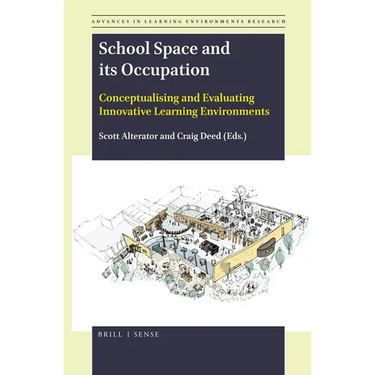

School Space and Its Occupation: Conceptualising and Evaluating Innovative Learning Environments - Paperback
 School Space and Its Occupation: Conceptualising and Evaluating Innovative Learning Environments - Paperback
$69.73
/
School Space and Its Occupation: Conceptualising and Evaluating Innovative Learning Environments - Paperback
$69.73
/

products.product.pickup_availability.unavailable

Your payment information is processed securely. We do not store credit card details nor have access to your credit card information.


by Scott Alterator (Volume Editor), Craig Deed (Volume Editor)
School Space and its Occupation addresses the ongoing and pressing need for justification of education and environmental innovation. Further, the increasingly important work of evaluating the new learning spaces brings attention to the need for conceptual and methodological clarity.
The editors have assembled a collection of leading authors to explore the links between education and design, progression of ideas in education and architecture, as well as making sense of pedagogical trends and spatial and design relevance. Post-occupancy evaluation is capable of informing both educational and architectural questions to generate sustainable adaptations for educators and designers. Part 2 focuses on the occupancy phase and examines the lived experience of schools to draw conclusions and make recommendations focused impacts and methodological progression.
Contributors: Renae Acton, Scott Alterator, Benjamin Cleveland, Craig Deed, Matthew Dwyer, Debra Edwards, Neil Gislason, Wesley Imms, Peter Lippman, Elizabeth Matthews, Marcus Morse, Vaughan Prain, Matthew Riddle, Warren Sellers, Rebecca Townsend, and Adam Wood.
Author Biography
Scott Alterator, Ph.D. (2016), La Trobe University, is lecturer of innovative and flexible learning at La Trobe University. His research focuses on linking innovative spaces and learning and the relevant adaptations of practitioners and students.
Craig Deed, Ph.D. (2005), La Trobe University, is an Associate Professor of Education. He has published books and many articles on innovation and agency in education, including the influence of emerging physical and virtual spaces on teaching and learning.

