
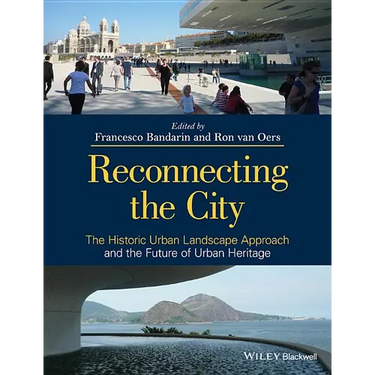

Reconnecting the City: The Historic Urban Landscape Approach and the Future of Urban Heritage - Paperback
 Reconnecting the City: The Historic Urban Landscape Approach and the Future of Urban Heritage - Paperback
$169.65
/
Reconnecting the City: The Historic Urban Landscape Approach and the Future of Urban Heritage - Paperback
$169.65
/

products.product.pickup_availability.unavailable

Your payment information is processed securely. We do not store credit card details nor have access to your credit card information.


by Francesco Bandarin (Editor), Ron Van Oers (Editor)
Historic Urban Landscape is a new approach to urban heritage management, promoted by UNESCO, and currently one of the most debated issues in the international preservation community. However, few conservation practitioners have a clear understanding of what it entails, and more importantly, what it can achieve.
- Examples drawn from urban heritage sites worldwide - from Timbuktu to Liverpool
- Richly illustrated with colour photographs
- Addresses key issues and best practice for urban conservation
Back Jacket
Historic Urban Landscape is a new approach to urban heritage management, promoted by UNESCO, and currently one of the most debated issues in the international preservation community. However, few conservation practitioners have a clear understanding of what it entails, and more importantly, what it can achieve.
Following the publication of The Historic Urban Landscape: Managing Heritage in an Urban Century, the approach is now further elaborated with a more practical slant and translates the notion into an operational set of management practices. In this follow-up book, the editors pull together specially commissioned chapters on best practice in urban heritage management from established professionals in the field. Drawn from a variety of disciplines related to urban management and conservation these authors present and discuss methodologies and practices to consider in the implementation of the Historic Urban Landscape approach as advocated by UNESCO.
The contributors are selected from professionals who have written, argued or debated about the role of historic cities in contemporary society. As well as their chapters, there are interviews with six high-profile people from different regions of the world giving their critical reflections on the UNESCO approach in relation to their own ideas on urban heritage conservation and city management.
Reconnecting the City: the Historic Urban Landscape Approach and the Future of Urban Heritage provides a thorough discussion, structured by themes on issues related to key topics in the field of urban management, from changing demographics and increasing urbanisation to the pressures of economic development and decentralisation; social interaction; and economic feasibility and financing of heritage conservation.
By presenting a range of methodologies and tools to support urban conservation in a way that is sensitive to cultural differences, the editors encourage a departure from the compartmentalized approaches of today's urban heritage management.
The book includes contributions from HH The Aga Khan, Rem Koolhaas, Stefano Bianca and Julian Smith - and many other internationally respected figures. The book's companion website http: //www.wiley.com/go/Bandarin/Historic_Urban_Landscape"
offers invaluable resources from UNESCO relating to the Historic Urban Landscape Approach, as well as additional illustrations and web-links.
Author Biography
Francesco Bandarin was UNESCO's Assistant Director-General for Culture from 2010 to 2014 and is now Professor of Urban Planning at the University Institute of Architecture of Venice. He was formerly Director of the UNESCO World Heritage Centre and the Secretary of the World Heritage Committee. He is trained as an Architect (Venice 1975) and Urban Planner (UC Berkeley 1977) and has pursued an academic career as Professor of Urban Planning at the University of Venice (IUAV) and a professional career as consultant for international organizations in the field of urban conservation and development. He has been actively involved in the Venice Safeguarding Project and in the preparation of Rome for the year 2000 Jubilee. As Director of the World Heritage Centre he has promoted the revision of the UNESCO recommendations on historic cities and has contributed to development of the debate on the role of contemporary architecture in historic cities, on the management of their social and physical changes and on the role of communities in the conservation of historic values.
Ron van Oers is Vice Director, World Heritage Institute of Training and Research for Asia and the Pacific (WHITRAP). He was formerly Programme Specialist for Culture at the UNESCO World Heritage Centre, coordinating the World Heritage Cities Programme and the international effort to develop new guidelines for urban conservation, which were adopted as the 2011 Recommendation on the Historic Urban Landscape. He is trained as an Urban Planner (Delft 1993) and received his doctorate (PhD, Delft 2000) on a research into the principles of Dutch colonial town planning (published as book). He is the Founding Editor (together with Dr. Ana Pereira-Roders) of the Journal of Cultural Heritage Management and Sustainable Development (JCHMSD), published by Emerald Group Publishing (UK) and a Member of the Editorial Advisory Board of Change Over Time International Journal of Conservation and the Built Environment, published by Penn Press, University of Pennsylvania's School of Design (USA).

