
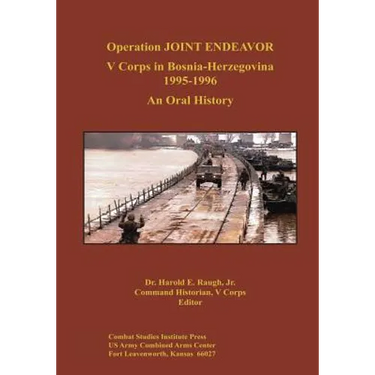

Operation JOINT ENDEAVOR: V Corps in Bosnia-Herzegovina, 1995-1996 - Paperback
 Operation JOINT ENDEAVOR: V Corps in Bosnia-Herzegovina, 1995-1996 - Paperback
$42.08
/
Operation JOINT ENDEAVOR: V Corps in Bosnia-Herzegovina, 1995-1996 - Paperback
$42.08
/

products.product.pickup_availability.unavailable

Your payment information is processed securely. We do not store credit card details nor have access to your credit card information.


by Harold E. Jr. Raugh (Author)
The Dayton Peace Accords, signed on 14 December 1995, formally ended the ethnic and religious conflict in Bosnia-Herzegovina and established a framework for full implementation of the provisions of the peace settlement. The following day, the UNSC (United Nations Security Council) adopted UNSC Resolution 1031, which authorized the NATO (North Atlantic Treaty Organization) "to establish a multinational IFOR (Implementation Force) under unified command and control" to help ensure compliance with the provisions of the Dayton Peace Accords. This NATO IFOR would operate under the "authority and subject to the direction and political control of the NAC (North Atlantic Council) through the NATO chain of command." The deployment of the IFOR, with a one-year mandate, was designated OJE (Operation JOINT ENDEAVOR) and marked the first major out-of-area peace enforcement operation in the alliance's half-century history. Moreover, this complex and challenging military operation included for the first time since World War II, American and Russian soldiers operating as allies, a feat unthinkable only six years earlier before the Berlin Wall fell in 1989. On 5 December 1995, NATO foreign ministers approved military planning for IFOR, which called for over 60,000 military personnel to serve in the NATO-led IFOR. More than 32 countries, including all NATO countries, thirteen PFP (Partnership for Peace) nations, and four other nations agreed to contribute forces to IFOR. The United States, United Kingdom, and France provided the largest national contingents. All forces served under OPCON (operational control) of NATO, with the exception of the Russian contingent. This contingent served OPCON directly to the SACEUR (Supreme Allied Commander-Europe), which was in charge of NATO military forces and also under TACON (Tactical Control of the commanding general, US 1st Armored Division. On 20 December 1995, only four days after the NAC approved OJE, the IFOR commander assumed military authority in Bosnia-Herzegovina from the commander of the UNPROFOR (United Nations Protection Force). While the approval of IFOR and related military developments and deployments took place seemingly very quickly in December 1995, these initiatives were crowned with success because, from the US Army perspective, they were the culmination of about three years of deliberate planning, thorough preparations, and intensive training by USAREUR (US Army, Europe) and its major subordinate command, V Corps. V Corps, which had moved its headquarters from Frankfurt to Heidelberg, Germany, only on 13 January 1995, made significant contributions to the command, planning, organization, operations, and accomplishments of this team effort. The commanding general of V Corps served as deputy commanding general, USAREUR Headquarters (Forward), in charge of the NSE (National Support Element) at the ISB (Intermediate Staging Base) at Taszar, Hungary. He was responsible for the deployment, sustainment, and later redeployment of US forces to and from Bosnia-Herzegovina. The V Corps Headquarters (Main) remained in Heidelberg and served as the plans headquarters for the operation. Moreover, based on guidance and directives from its higher headquarters (USAREUR), V Corps provided the majority of forces for the US national contingent for OJE, centered on the 1st AD (Armored Division). The 1st AD provided command and control and the nucleus of the multinational Task Force Eagle and it was accountable for peace enforcement operations in the American or Multinational Division-North, sector of Bosnia-Herzegovina. The V Corps was also responsible for the establishment and operations of Task Force Victory under the V Corps deputy commanding general and using the V Corps Artillery staff of commanding rear detachments, non-deploying units, and executing related missions.
Author Biography
Dr. Harold E. Raugh, Jr., is the Command Historian, US Army V Corps, Heidelberg, Germany. He previously served as the Command Historian, Defense Language Institute Foreign Language Center and Presidio of Monterey, Monterey, California, from 2002 to 2006. Dr. Raugh is a retired US Army Lieutenant Colonel of Infantry and served on active duty in the United States and in West Berlin; South Korea; the Persian Gulf; with the United Nations in Israel, Egypt, and Jordan; in Saudi Arabia; and as a NATO detachment commander in the former Yugoslavia. He also served as an Assistant Professor of History at the United States Military Academy at West Point, as well as at the Pentagon and at the National Security Agency. Dr. Raugh, who received his Ph.D. in History from the University of California, Los Angeles (UCLA), is the author or editor of seven military history books, including the highly acclaimed Wavell in the Middle East, 1939-1941: A Study in Generalship (London: Brassey's, 1993) and over 740 articles and book reviews published in prominent international military and historical journals. Dr. Raugh was elected a Fellow of the Royal Historical Society in the United Kingdom in 2001 and a member of the British Commission for Military History in 2008.

