
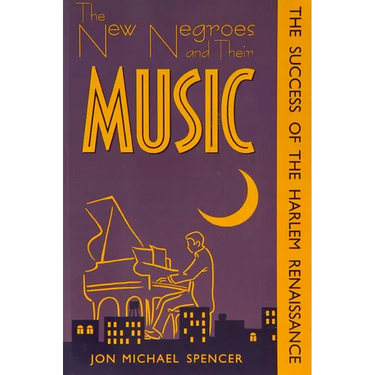

New Negroes & Their Music: Success of the Harlem Renaissance - Paperback
 New Negroes & Their Music: Success of the Harlem Renaissance - Paperback
$47.43
/
New Negroes & Their Music: Success of the Harlem Renaissance - Paperback
$47.43
/

products.product.pickup_availability.unavailable

Your payment information is processed securely. We do not store credit card details nor have access to your credit card information.


by Yahya Jongintaba (Author)
Boldly conceived and compellingly argued, this revisionist work offers a new interpretation of the Harlem Renaissance by focusing on its music. Jon Michael Spencer challenges the emphasis of earlier studies--which tended to bypass music in favor of literature--as well as their general conclusion that the Renaissance was a failure because it offered an inadequate solution to the old problem of racism.
Spencer's discussion encompasses the music and writings of a wide range of important figures, including William Grant Still, James Weldon Johnson, Roland Hayes, Alain Locke, and R. Nathaniel Dett. He argues that the singular accomplishment of the Harlem Renaissance composers and musicians was to achieve a "two-tiered mastery" their work drew on the "mood and spirit" of African American folk music while mastering the forms and techniques of the European classical tradition.
Spencer also contends that the Harlem Renaissance extended for three decades beyond the 1920s. He thus contests assertions that the arrival of the Great Depression effectively ended the Renaissance, as issues of economic survival subsumed artistic aspirations. In positing a much longer period for the Renaissance and offering evidence for it, Spencer argues that this flowering of African American creative endeavor constitutes a major cultural legacy that can only be described as a resounding success.
Back Jacket
Boldy conceived and compellingly argued, this revisionist work offers a new interpretation of the Harlem Renaissance by focusing on its music. Jon Michael Spencer challenges the emphasis of earlier historical studies - which have tended to bypass music in favor of literature - as well as their general conclusion that the Renaissance was a failure. Spencer's discussion encompasses the music and writings of a wide range of important figures, including James Weldon Johnson, Harry T. Burleigh, Roland Hayes, Marian Anderson, Alain Locke, William Grant Still, R. Nathaniel Dett, and Dorothy Maynor. He argues that the singular accomplishment of the Harlem Renaissance composers and musicians was to achieve a "two-tiered mastery" promoted by Johnson, Locke, the Harmon award, and Crisis and Opportunity magazines. Their work, Spencer says, drew on the "mood and spirit" of African American folk music while mastering the forms and techniques of the European classical tradition in music. Spencer also contends, with Locke, that the Harlem Renaissance had its roots in the turn of the century and extended for three decades beyond the 1920s. He thus contests assertions that the arrival of the Great Depression effectively ended the Renaissance, as issues of economic survival allegedly subsumed artistic aspirations. In positing a much longer period for the Renaissance and offering evidence for it, Spencer argues that this flowering of African American creative endeavor constitutes a major cultural legacy that can only be described as a resounding success.
Author Biography
Jon Michael Spencer is Tyler and Alice Haynes Professor of American Studies and professor of music at the University of Richmond. His books include Black Hymnody, Blues and Evil, The Rhythms of Black Folk, and, most recently, Re-Searching Black Music.

