
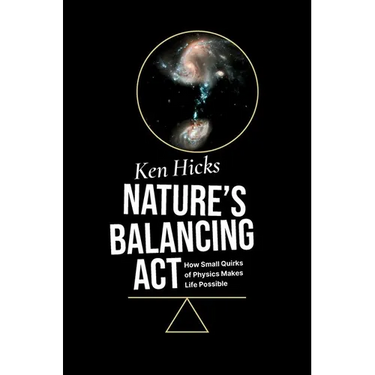

Nature's Balancing ACT: How Small Quirks of Physics Makes Life Possible - Hardcover
 Nature's Balancing ACT: How Small Quirks of Physics Makes Life Possible - Hardcover
$66.76
/
Nature's Balancing ACT: How Small Quirks of Physics Makes Life Possible - Hardcover
$66.76
/

products.product.pickup_availability.unavailable

Your payment information is processed securely. We do not store credit card details nor have access to your credit card information.


by Ken Hicks (Author)
Are the physical laws of our universe finely tuned, such that life can exist? What does this imply about how our universe formed? Questions like these are examined in Nature's Balancing Act, presented for a wide audience. From the Big Bang to present-day research, ranging from gravitational waves to experiments on antimatter, our physical laws are shown to be slightly off balance, allowing life to exist.
In its opening chapters, the following is asked: What would happen if the strong nuclear force, which binds protons and neutrons together, were slightly stronger or weaker? Would life still be possible? We know today that pushing the nuclear force off balance by just a few percent would create a different universe, unlike our own. Also, for life to exist, there must be a slight imbalance in the way matter and antimatter were created in the Big Bang. If matter and antimatter were exactly in balance, then our universe would not exist. These are just two examples of the fine tuning of physical laws that must happen for the cosmological conditions to be right for life to exist. If the universe wasn't "just so," you wouldn't be here to read about it! Even with a favorable universe, how did life on Earth begin? How did it survive all this time without being wiped out by a cosmic event? Can human life continue to exist for millions of years, or will we cause our own extinction? These topics are considered in the latter chapters of the book and provide a fascinating look at our existence on Earth and the possibility of life elsewhere.Author Biography
Ken Hicks is an experimental particle physicist. He has led experiments at accelerator facilities in the U.S. and Japan and has co-authored over 250 scientific journal articles. For 15 years, he wrote an astronomy column for the Columbus Dispatch. Now Professor Emeritus, he taught at Ohio University for 34 years and is currently a physicist at the U.S. Department of Energy. He is a Fellow of the American Physical Society and also served as Secretary-Treasurer for the Division of Nuclear Physics and as Program Director at the National Science Foundation. For fun, he does sprint triathlons.

