
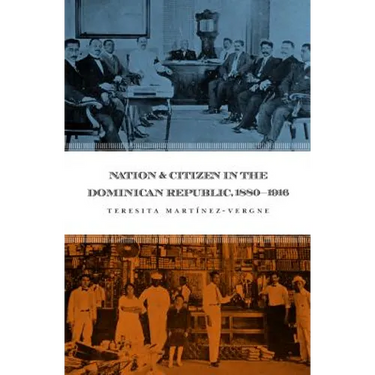

Nation and Citizen in the Dominican Republic, 1880-1916 - Paperback
 Nation and Citizen in the Dominican Republic, 1880-1916 - Paperback
$75.85
/
Nation and Citizen in the Dominican Republic, 1880-1916 - Paperback
$75.85
/

products.product.pickup_availability.unavailable

Your payment information is processed securely. We do not store credit card details nor have access to your credit card information.


by Teresita Martínez-Vergne (Author)
Combining intellectual and social history, Teresita Martínez-Vergne explores the processes by which people in the Dominican Republic began to hammer out a common sense of purpose and a modern national identity at the end of the nineteenth and beginning of the twentieth centuries.
Hoping to build a nation of hardworking, peaceful, voting citizens, the Dominican intelligentsia impressed on the rest of society a discourse of modernity based on secular education, private property, modern agricultural techniques, and an open political process. Black immigrants, bourgeois women, and working-class men and women in the capital city of Santo Domingo and in the booming sugar town of San Pedro de Macorís, however, formed their own surprisingly modern notions of citizenship in daily interactions with city officials.
Martínez-Vergne shows just how difficult it was to reconcile the lived realities of people of color, women, and the working poor with elite notions of citizenship, entitlement, and identity. She concludes that the urban setting, rather than defusing the impact of race, class, and gender within a collective sense of belonging, as intellectuals had envisioned, instead contributed to keeping these distinctions intact, thus limiting what could be considered Dominican.
Front Jacket
Martnez-Vergne examines the development of a sense of nationhood in the Dominican Republic, with particular focus on the cities of Santo Domingo (the capital) and San Pedro de Macor's (a booming sugar town) in the late 19th and early 20th centuries. She argues that the Dominican intelligentsia impressed on the rest of society a discourse based on modern agricultural techniques, secular education, private property, and an open political process, but black immigrants from the West Indies, bourgeois women, and working class men and women developed their own--suprisingly modern--notions of citizenship in their daily interactions with city officials.
Author Biography
Teresita Martínez-Vergne is professor of history at Macalester College. She is author of two previous books and coeditor of Contemporary Caribbean Cultures and Societies in a Global Context.

