
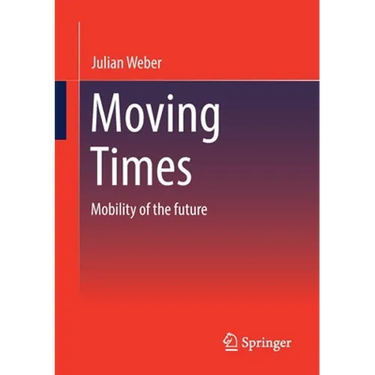

Moving Times: Mobility of the Future - Paperback
 Moving Times: Mobility of the Future - Paperback
$48.02
/
Moving Times: Mobility of the Future - Paperback
$48.02
/

products.product.pickup_availability.unavailable

Your payment information is processed securely. We do not store credit card details nor have access to your credit card information.


by Julian Weber (Author)
Will we really soon no longer be sitting behind the wheel of our own car, but will only be taken to our destination by driverless electric taxis? Should cities introduce car sharing? What role will electric scooters, cable cars or man-carrying drones play in the mobility systems of major cities? This book finally explains in a generally understandable way what is really behind buzzwords such as electric mobility, autonomous driving, digitalization and mobility services such as car sharing or ride-hailing, how far advanced these technologies are today, and above all in what relationships and dependencies they are to each other. In addition to the technical aspects, the legislative and social trends are also considered, which are important framework conditions that will have a decisive influence on the mobility of the future.
From the contents
- Mobility needs: Who wants to go where, when and why - and how will this change in the future?
- Technological trends: electromobility, digitalization, autonomous driving - what will the vehicles of the future be capable of?
- Car sharing, ride-hailing, e-scooters or public transport: What alternatives to the private car will there be in the future?
- Politics and society: How will the framework conditions for mobility develop in the future?- Mobility in transition: What should we do to prepare for the future?
Back Jacket
Will we soon be driven by autonomous electric taxis rather than steering our own car? Should cities introduce car sharing? What role will electric scooters, cable cars or man-carrying drones play? This book finally explains understandably what buzzwords like e-mobility, autonomous driving, digitalization, and mobility as a service really mean, how far advanced these technologies are today, and above all how they mutually depend on each other. In addition to the technical aspects, also legislative and social trends are considered, which represent important framework conditions with decisive influence on the mobility of the future.
From the contents
- Mobility needs: Who wants to go where, when, and why - and how will this change?
- Technological trends: e-mobility, digitalization, autonomous driving - what will the vehicles of the future be capable of?
- Car sharing, ride-hailing, e-scooters or public transport: What are future alternatives to the private car?
- Politics and society: How will the framework conditions for mobility develop in the future?
- Mobility in transition: What should we do to prepare for the future?
About the author
For many years, Dr. Julian Weber headed BMW's e-mobility innovation incubator, where he is today responsible for the digital transformation through utilization of vehicle generated data. Since 2008, he has been an adjunct professor at the Department of Automotive Engineering at Clemson University (USA).
This book is a translation of an original German edition. The translation was done with the help of artificial intelligence (machine translation by the service DeepL.com). A subsequent human revision was done primarily in terms of content, so that the book will read stylistically differently from a conventional translation.
Author Biography
For many years, Dr.-Ing. Julian Weber headed the innovation forge for electromobility of a well-known German automobile manufacturer, where he is now responsible for the digital transformation in the use of vehicle data. Since 2008, he has been an adjunct professor at the Department of Automotive Engineering at Clemson University (USA).

