
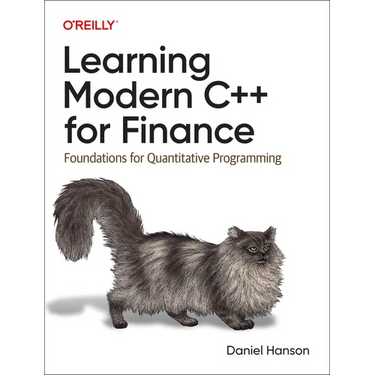

Learning Modern C++ for Finance: Foundations for Quantitative Programming - Paperback
 Learning Modern C++ for Finance: Foundations for Quantitative Programming - Paperback
$72.99
/
Learning Modern C++ for Finance: Foundations for Quantitative Programming - Paperback
$72.99
/

products.product.pickup_availability.unavailable

Your payment information is processed securely. We do not store credit card details nor have access to your credit card information.


by Daniel Hanson (Author)
This practical book demonstrates why C++ is still one of the dominant production-quality languages for financial applications and systems. Many programmers believe that C++ is too difficult to learn. Author Daniel Hanson demonstrates that this is no longer the case, thanks to modern features added to the C++ Standard beginning in 2011.
Financial programmers will discover how to leverage C++ abstractions that enable safe implementation of financial models. You'll also explore how popular open source libraries provide additional weapons for attacking mathematical problems. C++ programmers unfamiliar with financial applications also benefit from this handy guide.
- Learn C++ basics from a modern perspective: syntax, inheritance, polymorphism, composition, STL containers, and algorithms
- Dive into newer features and abstractions including functional programming using lambdas, task-based concurrency, and smart pointers
- Implement basic numerical routines in modern C++
- Understand best practices for writing clean and efficient code
Author Biography
Daniel Hanson spent over 20 years in quantitative development in finance, primarily with C++ implementation of option pricing and portfolio risk models, trading systems, and library development. He now holds a full-time lecturer position in the Department of Applied Mathematics at the University of Washington, teaching quantitative development courses in the Computational Finance & Risk Management (CFRM) undergraduate and graduate programs. Among the classes he teaches is graduate-level sequence in C++ for quantitative finance, ranging from an introductory level through advanced. He also mentors Google Summer of Code student projects involving mathematical model implementations in C++ and R.
Number of Pages: 428Dimensions: 0.87 x 9.19 x 7 INPublication Date: December 10, 2024

