
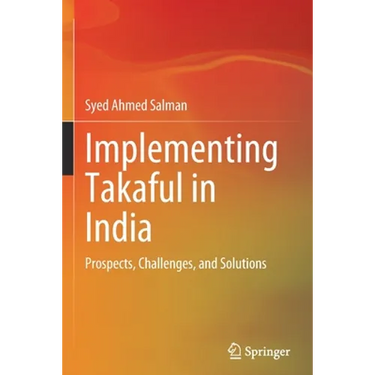

Implementing Takaful in India: Prospects, Challenges, and Solutions - Paperback
 Implementing Takaful in India: Prospects, Challenges, and Solutions - Paperback
$185.18
/
Implementing Takaful in India: Prospects, Challenges, and Solutions - Paperback
$185.18
/

products.product.pickup_availability.unavailable

Your payment information is processed securely. We do not store credit card details nor have access to your credit card information.


by Syed Ahmed Salman (Author)
Chapter One: Introduction of Takaful in IndiaIntroductionAppraisal of Indian Insurance MarketResearch Objectives Motivation and Significance of The StudyStructure of The Book
Chapter Two: Risk, Risk Management and Insurance: Conventional and Islamic DimensionsIntroductionDefinition and Classification of RiskCommon Types of Risks Faced by Individuals and Their Risk ManagementCommon Types of Risks Faced by Business Entities and Their Risk ManagementRisk in IslamIslamic Dimension of Risk ManagementDimension of InsuranceProhibited Elements of Conventional Insurance in the Sources of Shari'ahProhibition of Riba (Interest)Prohibition of Riba (Interest) in the Qur'an and HadithThe reasoning for the Prohibition of Riba (Interest)Prohibition of Gharar (Uncertainty)Prohibition of Gharar (Uncertainty) in the Qur'ān and ḤadīthThe reasoning for the Prohibition of Gharar (Uncertainty)Prohibition of Maysir (Gambling)The reasoning for the Prohibition of Maysir (Gambling)Prohibited Elements in Conventional InsuranceProhibition of Conventional Insurance in FatawaConclusion
Chapter Three: Takaful: Concept, Principles, Types, And ModelsIntroductionOverview of TakafulConcept of TakafulDefinitions of TakafulSharīʿah Framework of TakafulTakaful in the Qur'ānTakaful in ḤadīthTakaful: Shari'ah Scholar Point of ViewFundamental Differences between Takaful and InsuranceDevelopment of TakafulMain Types of TakafulGeneral TakafulFamily TakafulTakaful ModelsGeneral Takaful ModelsComparison of General Takaful ModelsFamily Takaful ModelsComparison of Family Takaful ModelsConclusion
Chapter Four: Research MethodologyIntroductionTheoretical Framework New Product Adoption TheoryNew Product Diffusion TheoryResearch MethodologyData and Research MethodsSamples, Sampling Method, and Data Collection MethodQuestionnaire DevelopmentInterview TechniqueStatistical MethodConclusion
Chapter Five: Findings from Interviews with Insurance OperatorsIntroductionProfile of IntervieweesAwareness and Knowledge of Conventional InsuranceKnowledge of Takaful Interviewee's Opinion on Determinants to Offer Takaful Interviewee's Opinion on Future Takaful Interviewees' Opinions on the Level of Difficulty to Promote Takaful in India Strengths of Introducing Takaful in IndiaWeaknesses of Introducing Takaful in India Overcoming Weaknesses to Offer Takaful in IndiaOpportunities to Introduce Takaful in IndiaThreats to Introduce Takaful in IndiaOvercoming Threats Related to Offering Takaful in India
Chapter Six: Conclusion and SuggestionsConclusionContribution of The ResearchSuggestions for Future ResearchRecommendations
Back Jacket
This book encourages insurance companies and regulators to explore offering Islamic insurance to boost the insurance industry in India. The distinctive features of Takaful also make it appealing even to non-Muslims. According to the 2012 World Takaful Report, India has immense potential for Takaful is based on the size of its Muslim population and the growth of its economy. However, it is surprising that Takaful has yet to be introduced in India since it has been offered in non-majority Muslim countries, such as Singapore, Thailand, and Sri Lanka. When the concept and practice of Takaful are examined, it is free from interest, uncertainty, and gambling. These are the main elements prohibited in Islam. However, it has been evidenced that these elements are also banned in teaching other religions believed by the Indians. Given this landscape, this book fills the gap in research on the viability of Takaful in India, focusing on its empirical aspects by examining the perception of Indian insurance operators toward Takaful.
Author Biography
Syed Ahmed Salman is Senior Lecturer (Assistant Professor) at Faculty of Business and Accountancy, Lincoln University College, Malaysia. He holds a Ph.D. in Islamic Banking and Finance from the Institute of Islamic Banking and Finance, International Islamic University Malaysia, and is a researcher of Islamic finance, with a particular focus on Takaful.

