
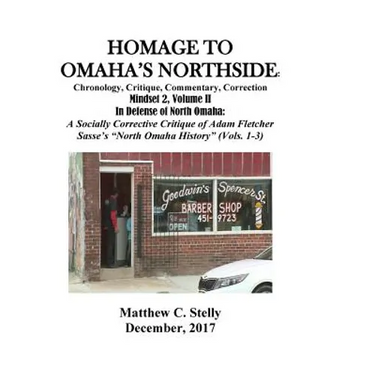

Homage to Omaha's Northside: Chronology, Critique, Commentary, Correction: Mindset 2, Volume II In Defense of North Omaha: A Socially Corrective Cr - Paperback
 Homage to Omaha's Northside: Chronology, Critique, Commentary, Correction: Mindset 2, Volume II In Defense of North Omaha: A Socially Corrective Cr - Paperback
$31.30
/
Homage to Omaha's Northside: Chronology, Critique, Commentary, Correction: Mindset 2, Volume II In Defense of North Omaha: A Socially Corrective Cr - Paperback
$31.30
/

products.product.pickup_availability.unavailable

Your payment information is processed securely. We do not store credit card details nor have access to your credit card information.


by Matthewq C. Stelly (Author)
With the selective history of North Omaha provided in Volume I of this series, Volume II begins with some closing chapters on North Omaha from Chapter I due to space considerations. These holdover chapters from Volume I include the Black church, the Black media in Omaha, African-American newspapers, the Black creative community (arts), North Omaha traditions (including festivals and African-American unity), Black politics and the history of civil rights in Omaha. From there the topic of North Omaha history morphs into my copious critique of Adam Fletcher Sassen's book on North Omaha, one that he had the unmitigated gall to self-publish and then pawn off as an authoritative piece. While admitting his approach, methodology and much of his interpretations were flawed, he nevertheless sought and continues to seek out a living on the speaking circuit though lacking in anything remotely resembling a history degree or background on urban planning or human geography. This section is exhaustive and is a searing critique of Sassen's voluminous work. I document how he was confronted and then ran for cover when the predicted critique was being written. His book contains some 124 chapters, all told, with many of them constituting no more than one or two pages. This fact in itself shows the short shrift that he paid to the history-rich area of an otherwise city of hillbillies, today ranking number 40 in total population. But the area being analyzed consists of an eight-square mile area on the northeastern sector of the city and it is one that has been mimicked, maligned, and exploited. Sassen covers churches (white), movie theaters, his version of "African American politics," hospitals and streetcars. He superficially covers the Jewish community, East Omaha, the town of Florence, schools and mortuaries. He spends more time writing about tales of ghosts in North Omaha's older structures than he does about the greatness of the Black politicians who paved the way for an incredible history of politics, culture and accomplishment. Comparatively, very little is written about African-American people, but plenty is penned in about the white exploiters, architects and others whose names continue to emblazon the street signs in the black community. I went through every chapter of Sassen's book and my critique is well over 400 pages. This is my homage to North Omaha: ranging from detailed and distinct description to defensive critique, commentary and correction. Bless the history of this small black community that has been largely overlooked by other parts of the country. Let the revelation of racism and documentation of decades of abuse and poverty pimping serve as the basis for enhanced attention and action by future Africentric urban scholars.
Author Biography
AUTHOR'S BIO Matthew C. Stelly is a doctoral student at the University of Wisconsin-Milwaukee working on a degree in Urban Education and Community Policy. He holds three Master's degrees: Urban Studies (1982), Urban Education (1983) and Political Science (2000). He is the former editor of the Milwaukee Courier newspaper, former director of the Great Plains Black Museum and the Plano (TX) African American Museum, and lead archivist for The Black Academy of Arts and Letters (TBAAL) in Dallas, Texas. Stelly has more than 2,500 articles in print and has won two national essay competitions. He is the founding director of the largest African-American neighborhood group in Nebraska, the Triple One Neighborhood Association and Parents Union. He is the father of five children - Mandla, Malik, Clariece, Charisse and Shannon -- and remains actively involved in community organizing and neighborhood development in several cities, including Milwaukee and Omaha.

