
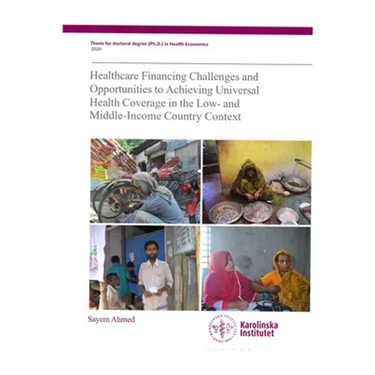

Healthcare financing challenges and opportunities to achieving universal health coverage in the low- and middle-income country context - Paperback
 Healthcare financing challenges and opportunities to achieving universal health coverage in the low- and middle-income country context - Paperback
$46.83
/
Healthcare financing challenges and opportunities to achieving universal health coverage in the low- and middle-income country context - Paperback
$46.83
/

products.product.pickup_availability.unavailable

Your payment information is processed securely. We do not store credit card details nor have access to your credit card information.


by Sayem Ahmed (Author)
In Bangladesh, on an average 62% of total healthcare spending was borne by households through out-of-pocket (OOP) payments annually during 2000- 2015. Because of such high OOP payments, a sizable proportion of households (15.7%) faced catastrophic health expenditure (CHE) and a number of them fell into poverty in 2010. Protecting households from such payments and consequently, the risk of impoverishment are desirable objectives of health systems worldwide. The Sustainable Development Goals (SDGs) resolution emphasized ensuring quality and affordable essential health services through Universal Health Coverage (UHC) by 2030. In order to achieve UHC, the World Health Organization (WHO) recommends to ensure the protection against the risk of large healthcare payments or CHE by spreading the risk among the population through pre-payments e.g., tax, social security contribution, insurance premium. Informal workers in the agricultural and non-agricultural sectors including readymade garments (RMG) workers constitute a large proportion of the total labor force (88%), who contribute to 64% of the total Gross Domestic Products of Bangladesh. Efforts should, therefore, be made to ensure sustainable quality healthcare for this group of workers by bringing them under pre-payment health schemes. Community-Based health insurance (CBHI) and employer-sponsored health insurance (ESHI) schemes were thus piloted among selected informal workers with an aim to increase utilization of medically trained healthcare providers (MTPs) at an affordable price.The main objective of this dissertation is twofold: firstly, to study the effect of the current healthcare financing system on the financial risk of households and secondly, to explore potential solutions through pre-payments schemes (CBHI and ESHI) for mitigating such challenges.

