
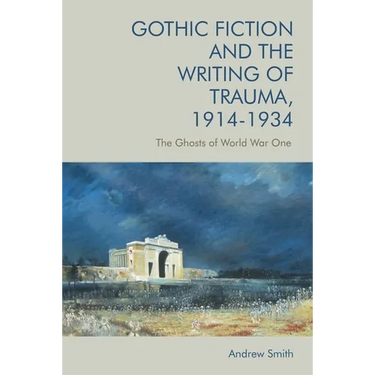

Gothic Fiction and the Writing of Trauma, 1914-1934: The Ghosts of World War One - Paperback
 Gothic Fiction and the Writing of Trauma, 1914-1934: The Ghosts of World War One - Paperback
$54.79
/
Gothic Fiction and the Writing of Trauma, 1914-1934: The Ghosts of World War One - Paperback
$54.79
/

products.product.pickup_availability.unavailable

Your payment information is processed securely. We do not store credit card details nor have access to your credit card information.


by Andrew Smith (Author)
This book examines how the representation of the ghost-soldier in literature published between1914-1934, both marks the presence of trauma and attempts to make sense of it. Andrew Smith examines short stories, novels, poems and memoirs that employ ghosts to reflect upon feelings of loss, paralleling the literary context with accounts of shell-shock which construe the damaged soldier as psychologically missing and therefore spectre-like.
The author argues that literary and non-literary texts repeatedly deploy a form of the uncanny, familiar from a Gothic tradition, as a way of reflecting upon grief. In support of this claim, he draws on fiction by well-known authors such as M. R. James, E. F. Benson, Dorothy L. Sayers, and Dennis Wheatley, alongside largely forgotten contributions to The Strand and other periodical publications such as The Occult Review.
Back Jacket
The first detailed analysis of Gothic literature and trauma in World War One This book examines the representation of the ghost-soldier in literature published from 1914-1934 both marking the presence of trauma and attempting to make sense of trauma. Andrew Smith examines short stories, novels, poems and memoirs that employ ghosts to reflect upon feelings of loss, paralleling the literary context with accounts of shell-shock which construe the damaged soldier as psychologically missing and therefore spectre-like. The author argues that literary and non-literary texts repeatedly deploy a form of the uncanny, familiar from a Gothic tradition, as way of reflecting upon grief. In support of this claim, he draws on fiction by well-known authors such as M. R. James, E. F. Benson, Dorothy L. Sayers and Dennis Wheatley, alongside largely forgotten contributions to The Strand and other periodical publications such as The Occult Review. Andrew Smith is Professor of Nineteenth-Century English Literature at the University of Sheffield where he co-directs the Centre for the History of the Gothic. He is the author or editor of over twenty published books including Gothic Death 1740-1914: A Literary History (2016) and The Ghost Story 1840-1920: A Cultural History (2010).
Author Biography
Andrew Smith is Professor of Nineteenth-Century English Literature at the University of Sheffield where he co-directs the Centre for the History of the Gothic. He is the author or editor of over 20 published books including Gothic Death 1740-1914: A Literary History (Manchester University Press, 2016), The Ghost Story 1840-1920: A Cultural History (Manchester University Press, 2010), Gothic Literature (Edinburgh University Press, 2007, revised 2013), Victorian Demons (Manchester University Press, 2004) and Gothic Radicalism (Macmillan, 2000). He is a past president of the International Gothic Association.

