
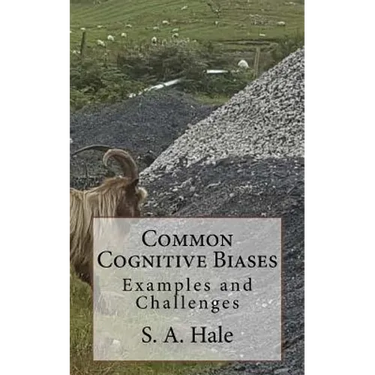

Common Cognitive Biases: Examples and Challenges - Paperback
 Common Cognitive Biases: Examples and Challenges - Paperback
$17.78
/
Common Cognitive Biases: Examples and Challenges - Paperback
$17.78
/

products.product.pickup_availability.unavailable

Your payment information is processed securely. We do not store credit card details nor have access to your credit card information.


by Terry E. Hale (Author), S. a. Hale (Author)
Our brain has many ways of doing its job, including tricks and shortcuts that help it work efficiently. Studies have shown, however, that these tricks and shortcuts can lead to making predictable mistakes. Does your brain lie to you, or does it at least filter reality? In this book, the authors will discuss some of the most common cognitive biases, how to identify these biases and heuristics cognition, how to potentially implement cognitive biases for use in your business and life arena and finally how to mitigate those cognitive biases. Research in Cognitive Psychology, Evolutionary Psychology, Cognitive Science, Neuroscience, Anthropology, and Human Reliability Engineering has identified over one hundred cognitive biases. These cognitive biases appear to be part of our evolutionary human brain and transcend cultures and generations. We can describe cognitive biases as a replicable pattern in perceptual distortion, inaccurate judgment, and illogical interpretation. Cognitive biases are the result of distortions in the human cognition that always lead to the same pattern of poor judgment, often triggered by a particular situation. Three main types of cognitive bias will be identified and discussed; Decision-making, Social Biases, and Memory Biases. Because of the authors' particular area of interest, we believe that by developing an understanding of cognitive biases, cyber defenders will be able to be adaptable and resilient to meet the rapid and ever-evolving threat to our national security. We must understand our vulnerabilities because humans are the weakest link in sales, marketing, and security. Once understood, training, tools, and processes can be implemented in both the business world and the Information Technology world of Information Security, Information Assurances, and cyber warfare.
Author Biography
Mr. S.A. Hale is a Computer Scientist with over 30 years of experiences. Predominantly utilizing an interdisciplinary approach that brings the human side to technology by combining Cognitive and Behavioral Science, with Computer and Security Engineering. Mr. Hale works in various areas including Security Engineering, Information Assurance, System Administration, Cyber Warfare, Cognitive System Engineering, and Software Engineering. Mr. Hale uses the human-centric computing approach during his normal day as a Cyber Technical Lead, System Administrator, and Information System Security Officer (ISSO) for several classified laboratories. He has provided engineering and analysis support to government and commercial groups both foreign and domestic. Additionally, Mr. Hale is an Adjunct Professor of Computer Science where he teaches courses in System Security Management, Digital Forensics, Cyber Ethics, and Javascript and other courses. You may contact Mr. Hale at ProfessorHale@gmail.com or AbbyNormalResearch@gmail.com Ms. Terry Hale has been fascinated with the decision-making process since she began dealing with customers in her family's business when she was a young teen. Throughout her adult life, she has studied social engineering while working in a career that includes sales, teaching, corporate training, and NASA and Department of Defense technical support. Currently, Terry is a full-time glass artist and jewelry designer. Her designs can be found in fine art galleries and shows throughout the southeast US. In addition to teaching in her studio, Terry regularly teaches at John C. Campbell Folk School in Brasstown NC, Appalachian Center for Craft (Tennessee Tech) in Smithville TN, and at Essence of Mulranny, County Mayo, Ireland. She depends on her study of cognitive biases while teaching and decision making while selling her artwork. You contact Terry at terry@halefireglass.com or AbbyNormalResearch@gmail.com

