
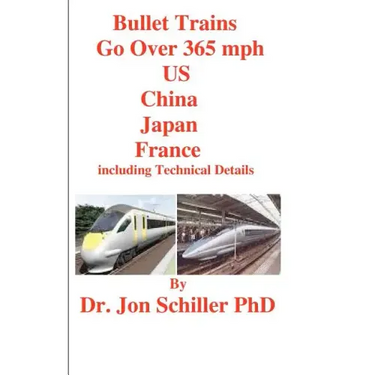

Bullet Trains Go Over 365mph US, China, Japan, France - Paperback
 Bullet Trains Go Over 365mph US, China, Japan, France - Paperback
$74.50
/
Bullet Trains Go Over 365mph US, China, Japan, France - Paperback
$74.50
/

products.product.pickup_availability.unavailable

Your payment information is processed securely. We do not store credit card details nor have access to your credit card information.


by Jon Schiller (Author)
Bullet train may refer to: 1964 Shinkansen, Japan 130 mph This new line between Tokyo and Osaka provided the first regular service operating at speeds above 100 mph. The Shinkansen's aerodynamic design earned it the nickname "bullet train." 1981 TGV, France 161.6 mph When this high-speed rail opened, it became the fastest regularly running line in the world, shuttling passengers 264 miles between Paris and Lyon in just 2 hours, 40 minutes. 2004Shanghai Maglev, Chin 267 mph The fastest passenger train in the world, this line zips from Pudong International Airport to Shanghai via an electromagnetic reaction created between the cars and the tracks. 2007 TGV, France 367 mph A souped-up, 25,000-hp TGV with oversize wheels holds the current record for non-maglev trains. Journalists on the title run reported dizziness at 300 mph and difficulty standing at around 335 mph. Believe it: Bullet trains are coming. After decades of false starts, planners are finally beginning to make headway on what could become the largest, most complicated infrastructure project ever attempted in the US. The Obama administration got on board with an $8 billion infusion, and more cash is likely en route from Congress. It's enough for Florida and Texas to dust off some previously abandoned plans and for urban clusters in the Northeast and Midwest to pursue some long-overdue upgrades. The nation's test bed will almost certainly be California, which already has voter-approved funding and planning under way. But getting up to speed requires more than just seed money. For trains to beat planes and automobiles, the hardware needs to really go fast on rails. Officials are pushing to deploy state-of-the-art rail rockets. Next stop: the future. 1964 Shinkansen, Japan 130 mph This new line between Tokyo and Osaka provided the first regular service operating at speeds above 100 mph. The Shinkansen's aerodynamic design earned it the nickname "bullet train." 1981 TGV, France 161.6 mph When this high-speed rail opened, it became the fastest regularly running line in the world, shuttling passengers 264 miles between Paris and Lyon in just 2 hours, 40 minutes. 2004 Shanghai Maglev, China 267 mph The fastest passenger train in the world, this line zips from Pudong International Airport to Shanghai via an electromagnetic reaction created between the cars and the tracks. 2007 TGV, France 367 mph A souped-up, 25,000-hp TGV with oversize wheels holds the current record for non-maglev trains. Journalists on the title run reported dizziness at 300 mph and difficulty standing at around 335 mph. We look forward to how fast the Bullet Train planned for the Central Valley of California will be.
Author Biography
Jon Schiller received the BS in Physics from the California Institute of Technology (Caltech) and the MS and PhD from the University of Southern California (USC). As an executive of an Aerospace Corporation he designed guidance and control systems for aircraft and missiles. After retiring he became active writing documentary books using research from the Internet in addition to creating books about Options Trading strategies which used his mathematical skills.

