
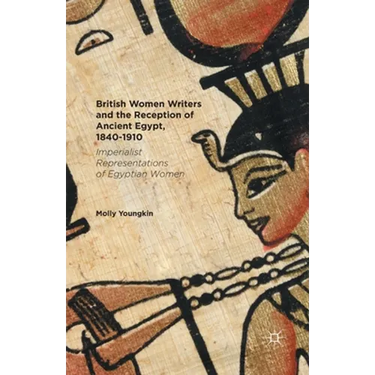

British Women Writers and the Reception of Ancient Egypt, 1840-1910: Imperialist Representations of Egyptian Women - Paperback
 British Women Writers and the Reception of Ancient Egypt, 1840-1910: Imperialist Representations of Egyptian Women - Paperback
$96.08
/
British Women Writers and the Reception of Ancient Egypt, 1840-1910: Imperialist Representations of Egyptian Women - Paperback
$96.08
/

products.product.pickup_availability.unavailable

Your payment information is processed securely. We do not store credit card details nor have access to your credit card information.


by Molly Youngkin (Author)
Focusing on British women writers' knowledge of ancient Egypt, Youngkin shows the oftentimes limited but pervasive representations of ancient Egyptian women in their written and visual works. Images of Hathor, Isis, and Cleopatra influenced how British writers such as George Eliot and Edith Cooper came to represent female emancipation.
Back Jacket
This book shows how British women writers' encounters with textual and visual representations of ancient Egyptian women such as Hathor, Isis, and Cleopatra influenced how British women represented their own desired emancipation in novels, poetry, drama, romances, and fictional treatises. Molly Youngkin argues that canonical women writers such as Florence Nightingale and George Eliot--and less canonical figures such as Katharine Bradley and Edith Cooper (who wrote under the name 'Michael Field') and Elinor Glyn--incorporated their knowledge of ancient Egyptian women's cultural power in only a limited fashion when presenting their visions for emancipation. Often, they represented ancient Greek women or Italian Renaissance women rather than ancient Egyptian women, since Greek and Italian cultures were more familiar and less threatening to their British audience. This notable distinction opens up discussions about the history of British women, their writing, and the British view on gender inthe nineteenth and early twentieth centuries.
Author Biography
Molly Youngkin is Professor of English at Loyola Marymount University, Los Angeles, USA. Her previous publications include Feminist Realism at the Fin de Siècle: The Influence of the Late-Victorian Woman's Press on the Development of the Novel (2007) and an annotated edition of Sarah Grand's 1888 novel Ideala (2008).

